A hybrid slab points to a new stage for timber prefabrication
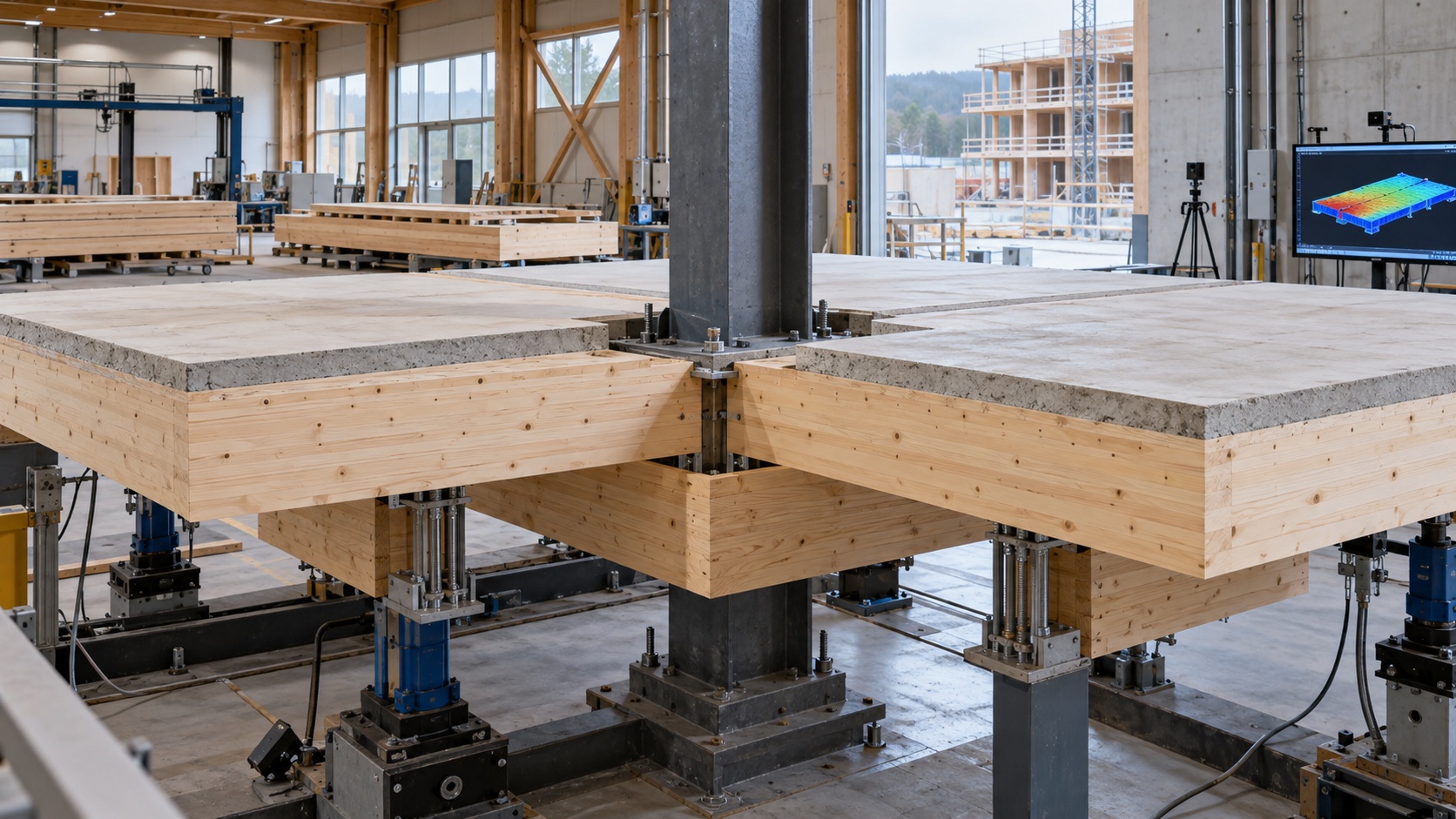
A 20-tonne load test has just turned a research concept into a tangible signal for the timber construction industry. Researchers at the University of Stuttgart tested a full-scale, 9 by 5 metre timber-concrete composite slab supported on columns and designed to span in two directions. The result is more than another structural component. It proposes a different way to design, manufacture and assemble floors for multi-storey buildings.
The news, published on September 23, describes progress on UniversalTimberSlab, a system combining prefabricated glued-laminated timber segments with a reduced amount of concrete. Its demonstrator had an effective two-way span of 8 by 4 metres and a total depth of 36 centimetres, comparable to a conventional reinforced-concrete slab carrying similar loads across similar spans. According to the research team, it used roughly two-thirds less reinforced concrete and recorded a maximum deformation of only 12 millimetres during testing.
For manufacturers and designers, the most consequential feature is the architecture of the system. Instead of relying on deep beams or load-bearing walls that impose a rigid grid, the slab is divided into parts whose geometry and orientation respond to the flow of forces. The glulam laminations remain straight, an important choice because it makes use of processes and equipment already found in engineered-wood plants. The innovation is not about manufacturing elaborate curves; it is about intelligent segmentation and placing wood fibre where it contributes most.
That approach allows loads to travel to point supports while the slab works in two directions. Architecturally, it frees the interior layout: offices, homes, shops or educational spaces can be arranged without requiring each partition to perform a structural role. It also supports future alterations, an increasingly valuable property when a building's environmental service life depends as much on adaptability as on the energy and materials consumed during construction.
From the digital model to the production line
The project illustrates how digitalisation is beginning to influence decisions once resolved through repetition. AI-assisted tools generate detailed floor-plan alternatives and immediately assess what happens when a column is moved: cost, depth, material consumption and environmental performance all change. Those options are checked through finite-element simulations that predict deformation and vibration before the first part is cut.
For industry, this workflow requires tighter integration among structural analysis, modelling, CNC machining, logistics and erection. Every segment can receive geometric and fibre-orientation data directly from the model. Automation does not remove the need for judgement, however. It increases the importance of controlling tolerances, moisture, bonding quality, concrete interfaces, connectors and installation sequence. The more closely a component is optimised, the less room remains to compensate for errors on site.
The demonstrator was built in three months, and its segments were installed in two days. That is an encouraging benchmark for prefabrication, but it should not be mistaken for complete commercial validation. Fire behaviour, acoustic separation, service moisture, connection fatigue, protection in transit and potential disassembly will need to be resolved for every market and regulatory system. The structural test confirms a crucial stage, not the end of development.
Impact on plants and suppliers
If the technology progresses toward repeatable projects, it could broaden the work available to glulam producers, machining centres and engineering companies. The opportunity lies in relatively standard components that can be combined through parametric design to accommodate both regular and irregular plans. It points toward variable-series manufacturing: parts made with familiar processes but coordinated as a building-specific solution.
It also changes the role of component suppliers. A column-supported system concentrates forces around critical nodes, so connectors, inserts, adhesives and hybrid interfaces require traceability and dimensional control. Quality is no longer judged only by surface appearance or a board's nominal strength. It depends on the ability of all elements to perform together as a predictable assembly.
The reduction in structural depth — estimated by the researchers at 30 to 70 centimetres compared with conventional timber systems using deep beams — may create economic effects beyond the slab itself. For a constant interior clear height, it can reduce facade area or help fit floor levels more efficiently within an urban envelope. That is where an indirect benefit can offset additional engineering: less constructed volume for the same usable space and greater flexibility over time.
From prototype to an industrial chain
The next step is a three-storey, 1,400-square-metre pilot building planned in Oberkochen, Germany. That project will expose variables an isolated test cannot reproduce: production rhythm, weather protection, trade coordination, accumulated tolerances and connection performance on an actual site. Technology transfer will only be fast if the system can be documented, priced and certified without permanent dependence on its original research team.
For Latin America, where industrialised timber construction is advancing unevenly, the lesson is broader than this specific solution. Competitiveness may not come from replacing every established process with new machinery. It may emerge by connecting existing capabilities more effectively: glulam, CNC cutting, advanced analysis, prefabrication and dry assembly. The challenge is to translate a digital model into robust instructions for factories and job sites operating under real conditions.
The Stuttgart slab does not eliminate concrete; it uses the material selectively where its stiffness and mass are useful. That combination carries a wider lesson for the sector. The transition to lower-impact buildings does not depend on presenting materials as absolute rivals, but on assigning each one a precise and measurable function. If the next trials confirm safety, repeatability and competitive cost, the deepest innovation will be productive: moving from isolated components to systems designed, manufactured and verified as one continuous chain.