Predictive maintenance in woodworking: from "the machine stopped" to a control board that prevents rework
Predictive maintenance adoption is accelerating across manufacturing, and wood is no exception. Combining sensors (vibration/temperature), software and disciplined routines helps anticipate failures in motors, spindles, fans and dust extraction-tackling the most expensive outcome: line stoppages that turn into quality drift and rework.
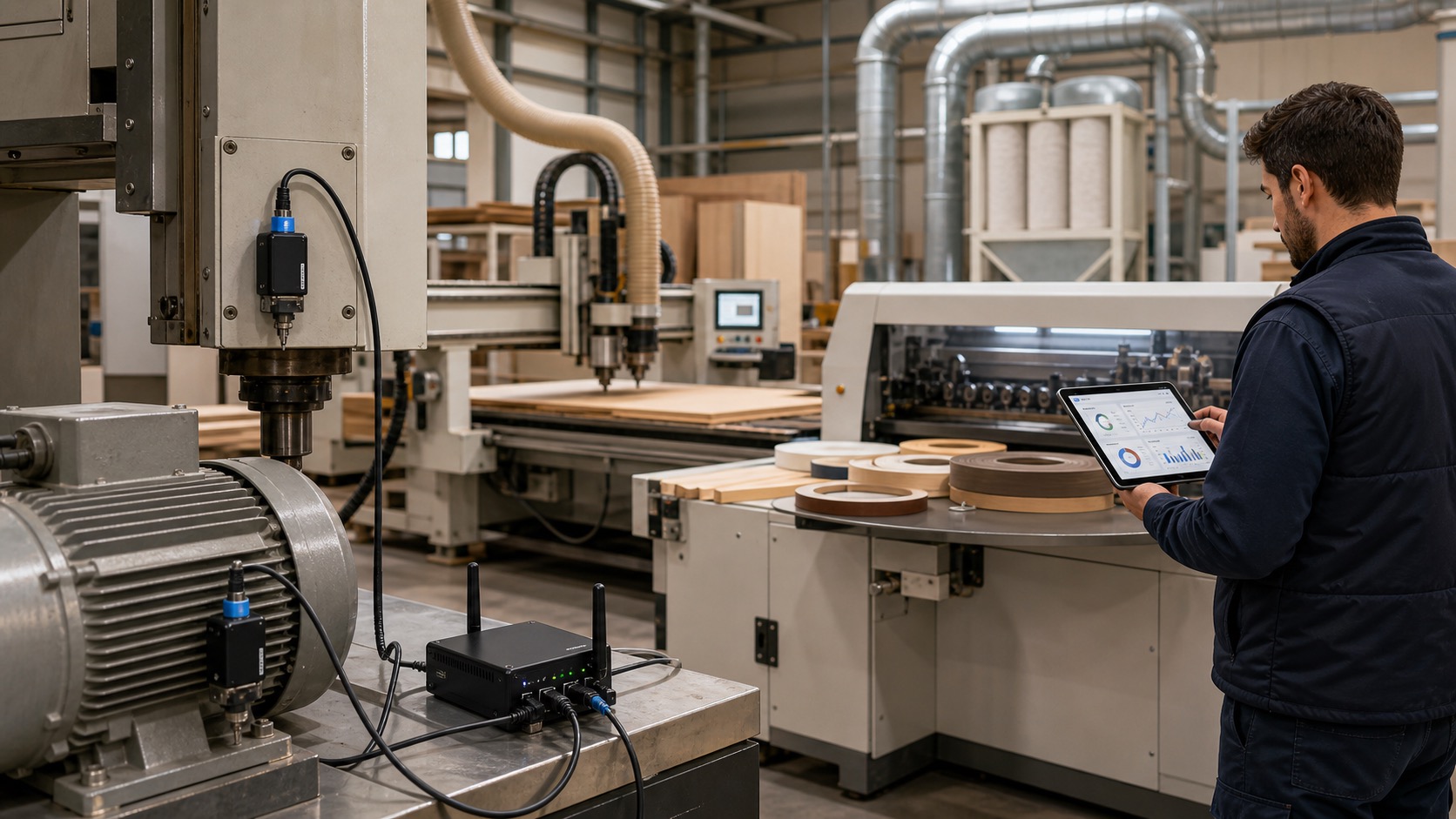
In a furniture factory or an industrial joinery shop, the problem is never "one machine down" in isolation. The real damage is what breaks around it: the half-finished batch, the edge-banding line that cools and starts failing again, the press that misses its window, the finishing booth that loses airflow, the delivery promise that slips-and eventually the cost of rework. That is why maintenance is moving from a back-office function to a productivity discipline. Over the last few weeks, clear signals of that shift have surfaced. A survey shared by Fluke in early May 2026 reported that predictive maintenance adoption doubled and reactive maintenance decreased. In parallel, automation and energy suppliers are pushing continuous monitoring solutions built around vibration and temperature sensors plus analytics platforms designed to translate mechanical signals into operational decisions. Read without brand names, the industry message is simple: **maintenance is becoming a data system**. ## Why predictive maintenance matters especially in wood Wood manufacturing combines two realities that make "fix it at the last second" expensive. First, many operations are flow-based: if one station stops, everything downstream stops with it. Second, much of the value sits in dimensional and surface quality. A machine deviation does not always show immediately; it may show up later as a door that does not close, an edge that delaminates, a module that does not fit, or a finish that reveals marks. Technically, a typical panel and furniture chain includes naturally wear-prone assets: - Motors and gearboxes in saws, beam saws, CNC routers and feeders. - Spindles, bearings and linear guides in CNC equipment. - Edgebanders with multiple units (motors, cutters, scrapers, rollers and thermal systems). - Fans, cyclones, filters and dust extraction (infrastructure that defines safety and process stability). - Auxiliary systems (vacuum, hydraulics, compressed air). When one component degrades, the failure is rarely "clean." It can be vibration that leaves marks, heat that drifts tolerances, or instability that turns into scrap. Predictive maintenance targets precisely that: detecting the issue before it becomes defective product. ## Sensors + context: the core of the approach One key lesson is that sensors alone are not enough. A vibration or temperature reading is only a symptom. To become action, it needs context: which asset it is, what regime it operates in, what "normal" looks like, and which thresholds should trigger intervention. Most continuous monitoring approaches follow a similar structure: 1) Sensors installed on critical assets to capture vibration and temperature continuously. 2) A gateway/edge device to aggregate signals and feed a platform. 3) Software that adds analytics, rules and alerts to prioritize action. 4) An operating loop: alert ? inspection ? intervention ? learning (thresholds and routines are refined). Step four is what separates "technology" from "results." In wood, where a shop culture can reward firefighting, the shift is cultural: from fixing to documenting. ## What you can actually anticipate Predictive maintenance is not magic. It will not prevent every failure. But it can anticipate a set of common issues with a high cost/impact ratio: - Bearings beginning to degrade (rising vibration, sustained temperature). - Imbalance or misalignment in fans and motors (signature vibration patterns). - Lubrication problems (temperature and noise before failure). - Increased friction/load in spindles and guides (trends that precede "break" events). - Degradation in dust extraction components (performance drops that affect cleanliness, safety and quality). In an edgebander, for instance, a roller or milling unit that drifts into abnormal vibration is not only a downtime risk-it can start leaving marks or changing edge geometry. That is where predictive maintenance does not just "save maintenance." It saves complaints. ## Industry impact: the real KPI is rework In wood manufacturing, the metric that hurts most is rework. It is expensive because it consumes skilled time, ties up machines and creates waste. It is also expensive because it erodes trust: customers may tolerate a delay; they tolerate repeated defects less. Predictive maintenance becomes compelling when it links to operational KPIs: - Avoided downtime hours (including micro-stops that break flow). - Lower scrap and fewer out-of-tolerance parts. - Fewer claims tied to delamination, geometry or surface marks (when root causes are vibration/setup drift). - More stable energy behavior (motors operating within range, fewer overloads). At its core, predictive maintenance is a strategy to produce "the same way" every day. That repeatability is the foundation for scaling. ## What comes next: from pilots to factory discipline Adoption is growing, but the near future will not be just "adding sensors." It will be professionalizing the discipline: - Selecting critical assets (you do not monitor everything; you monitor what breaks flow). - Establishing baselines per machine and operating regime. - Integrating maintenance with production (intervention windows, spares and coordination). - Training people to interpret signals and execute routines (so alerts do not stay on a screen). This is also an opportunity for the sector: using predictive maintenance as a reason to organize processes. Plants that learn to measure vibration and temperature often end up measuring moisture, tolerances and quality more rigorously. The habit spreads. ## Editorial close Wood manufacturing is entering a stage where competing is not only about design or raw material. It is about continuity. And continuity is built by avoiding the most expensive hidden cost: stopping, losing quality and reworking. Predictive maintenance does not replace craftsmanship; it makes it smarter. It turns mechanical signals into decisions and, when implemented with method, shifts a plant from reactive mode toward control-board thinking. In a market of tight lead times and high expectations, that difference can decide who scales and who stays limited by downtime.