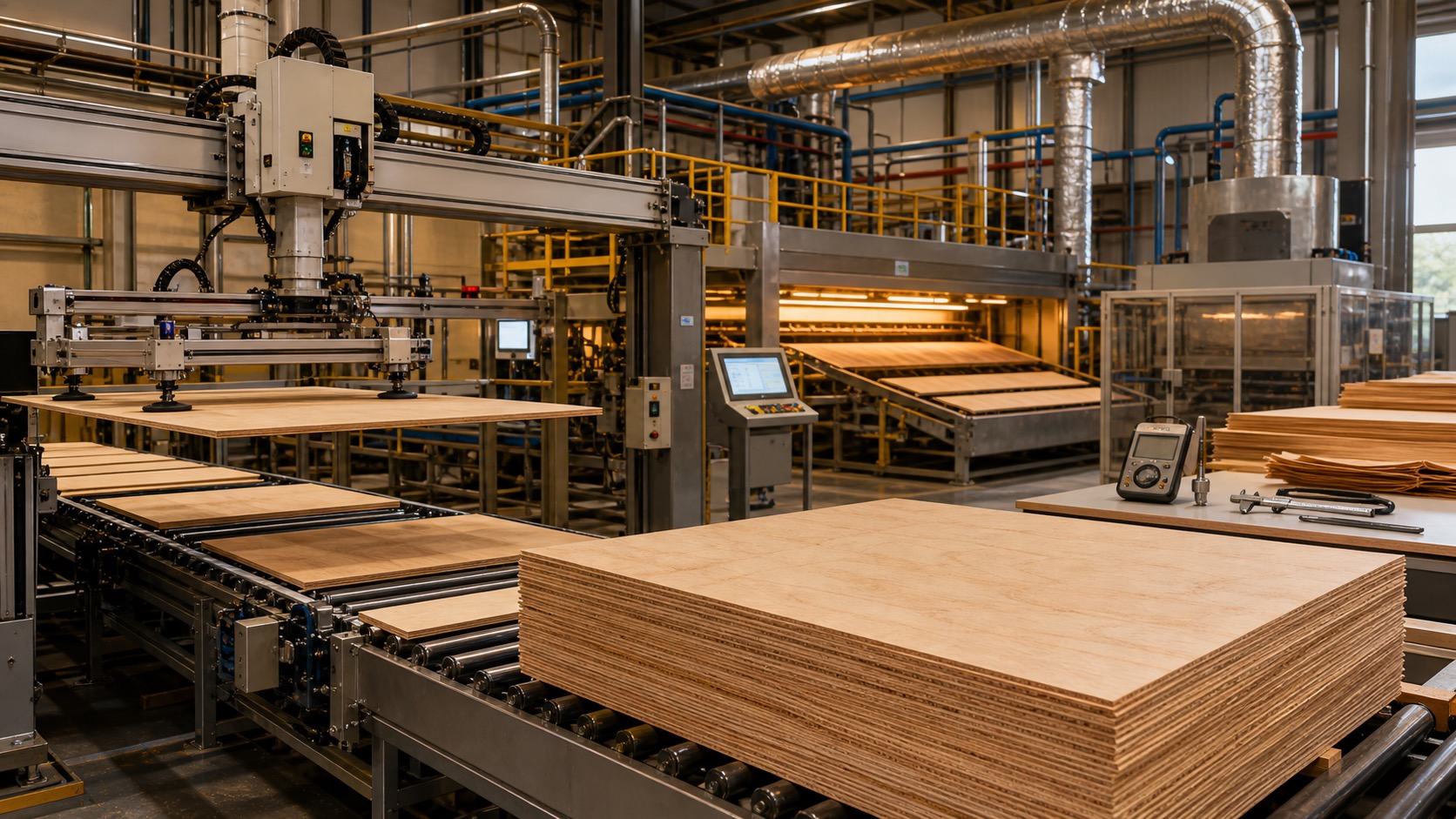
Plywood 2.0: industrial modernization, efficiency, and bio-based binders in the new race for panels
A recent modernization investment in a European plywood mill shows where the sector is heading: more automation across the flow, stronger in-line quality control, and growing pressure to cut footprint without sacrificing performance. Panels are moving from commodity thinking to a technology platform where energy, fibre and chemistry are decided in the same equation.
Plywood is entering a quiet but decisive phase. Not because laminated wood is new-it is mature industrial history-but because the context that defines competitiveness is changing. In a market that demands faster construction, longer-lasting interiors and more transparent supply chains, panels are no longer judged only by cost per square meter. They are judged by stability, repeatability, emissions, traceability and the ability to deliver volume without surprises. That transition becomes visible when a mill invests not in an isolated machine but in the entire flow. In April 2026, Latvijas Finieris announced a €29 million investment to modernize and improve efficiency at its Riga plywood mill. Read as corporate news, it is one data point. Read as an industry signal, it condenses key trends: material handling automation, yield improvements, energy efficiency, process stability and a more rigorous approach to quality. ## What "real" modernization means in plywood In plywood, modernization is not only about changing a press. The product relies on an interdependent chain: veneer preparation, drying, grading, gluing, layup, pressing, conditioning, calibration/sanding and, often, surface finishing. When one step falls out of balance, the cost shows up as scrap, rework or inconsistent quality. That is why the most effective upgrades tend to focus on three levers: 1) **Material handling and less manual touch.** Every transfer of panels or veneer stacks is time, damage risk and variability. Automated stacking, transfer and sorting are not "nice-to-haves"-they reduce dents, contamination and idle time. 2) **In-line quality control.** Defects should not be discovered at the end. The direction is earlier detection: moisture measurement, thickness verification, density checks and press parameter monitoring. Earlier feedback prevents entire lots from drifting. 3) **Energy efficiency and process stability.** Drying and pressing are energy intensive. Improving efficiency is not only cost reduction; it is stability. Better thermal profiles, timing and heat recovery often translate into more consistent boards. The summary is simple: modernization reduces uncertainty. And reduced uncertainty is the foundation of real productivity. ## The axis that is reshaping panels: binder chemistry If one theme is rewriting the conversation across panel categories (plywood, MDF, particleboard), it is adhesives. Bonding defines long-term durability under moisture, thermal cycling and load. But adhesives also shape emissions, odor, working conditions and embodied carbon. Over the last few years, the panel industry has faced a double pressure: maintain or improve performance (water resistance, delamination resistance, dimensional stability) while reducing environmental impact and emissions. That drives work on lower-emission formulations, optimized consumption, and bio-based alternatives. One concept gaining relevance is **using lignin**-a natural wood component-as part of panel binder systems. Instead of relying entirely on fossil-based resins, research and product development explore replacing a portion of the binder with biomass-derived solutions. The technical bar is high: a binder must be stable, process-compatible at industrial scale, repeatable, and compliant with performance testing. But the incentive is equally high: if panels can lower footprint without losing properties, they improve competitiveness across markets. ## What this means for manufacturers: investing along the full curve In Latin America, the question is often "which machine are we missing?" or "which line upgrade pays back?" International experience suggests advantage comes when investment targets the full curve: raw material + energy + process + chemistry + quality control. For plywood producers-and for heavy panel users-this translates into practical shifts: - **More precise specifications:** target moisture, tolerances, bond performance requirements and test methods. - **Total-cost thinking, not only price:** scrap, claims, installation time and durability. - **Traceability expectations:** wood origin, lot consistency, documentation and compliance. - **Chemistry awareness:** compatibility with coatings, edgebanding, assembly adhesives and end-use conditions. In short: panels move from generic input to engineered component. ## What's next: more industrial, more measured, more circular If modernization and bio-based binders signal the direction, the near future is likely to show four traits: 1) **More plant data:** sensors and parameter traceability to reduce scrap and stabilize lots. 2) **More thermal efficiency:** heat recovery and optimized drying/pressing control to cut consumption and improve consistency. 3) **More chain integration:** from wood selection to end use, with documentation that travels with the product. 4) **More rigorous circularity:** not slogans, but verifiable outcomes-lower footprint, less waste, longer life, and, where feasible, more bio-based content in binder systems or improved material efficiency. ## Editorial close Plywood is not a viral topic, but it sits at the center of a real transformation: advanced industrialization of panels. Modernization and efficiency investment, combined with the push for more sustainable binders, show that panels are moving beyond commodity thinking. In the next decade, competitive advantage will not be producing more at any cost. It will be producing better-less variation, less waste, more evidence. And in that race, plywood-well made, measured and traceable-can remain one of the most reliable materials in the wood ecosystem.