From treatment to material design: the rise of built-in fire protection for wood panels and engineered timber
Manufacturers are exploring fire-retardant systems integrated into the substrate to reduce jobsite uncertainty while balancing emissions and performance.
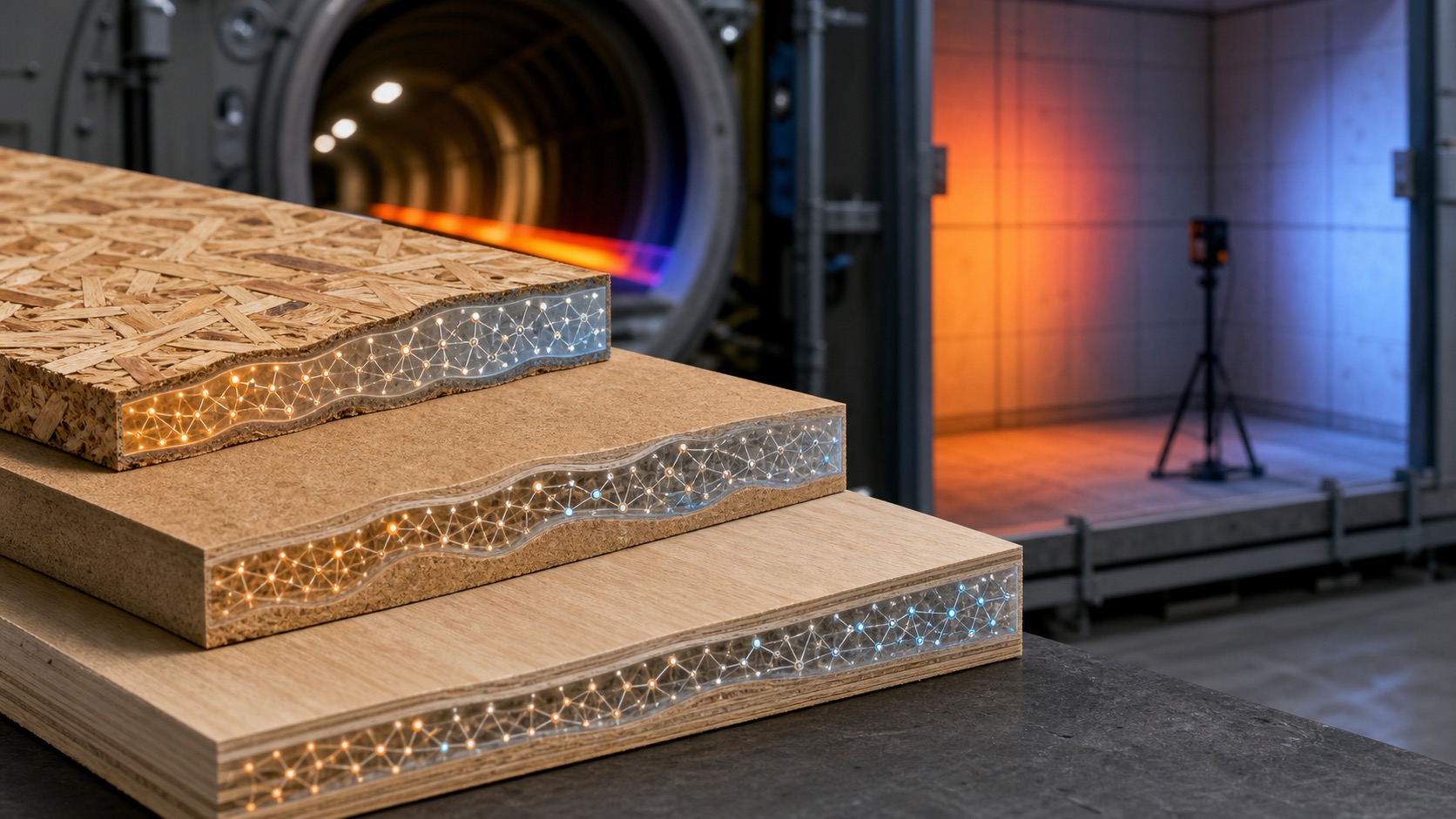
The wood conversation has shifted. It is no longer only about replacing carbon-intensive materials or speeding up projects with industrialized systems. In many markets, fire performance has become the deciding lens-especially as wildfire exposure expands and urban fire scenarios grow more complex. That shift is pushing a clear idea into mainstream manufacturing: move fire protection *inside* the product so it stops being an add-on treatment and becomes a property engineered into the panel or timber itself. A recent industry note helped put this trend into sharper focus. Woodworking Network (April 22, 2026) reported on a partnership aimed at developing fire-retardant solutions intended to be integrated into high-volume wood products such as OSB, plywood, and MDF. Beyond the corporate headline, the signal is structural: when the discussion reaches commodity panels-the backbone of interior fit-out and light construction-this is no longer a niche conversation. It is a manufacturing and specification shift that can influence how products are made, tested, and purchased. Why "how it's delivered" matters as much as the chemistry Fire risk management in wood has traditionally relied on three pillars: system design (assemblies, protective layers, detailing), surface solutions (coatings, intumescent paints, claddings), and chemical treatments applied to wood (soaking, pressure treatment, and related methods). That approach can work-but it also creates a practical weakness: many surface-dependent solutions assume perfect continuity, perfect installation, and long-term maintenance. As risk tolerance tightens-driven by codes, insurers, and WUI (wildland-urban interface) realities-manufacturers and specifiers are looking for ways to reduce uncertainty. Built-in fire protection addresses that uncertainty directly. If a retardant is fixed within the substrate or engineered into the product's internal structure, performance is less dependent on flawless field application and less vulnerable to abrasion, impact, moisture cycling, or partial damage. What "built-in" means in real production terms In manufacturing, "integrated" is not a marketing adjective-it is a process decision. Where do you add the chemistry (before drying, during blending, through the resin system, via pre-impregnation)? How do you control distribution? What are the downstream effects? Panel production is already a tight choreography of variables: moisture, pressing temperature and time, resin viscosity and cure kinetics, fines content, target density, density profile, and emissions. Introducing a fire-retardant package can shift cure behavior, affect press performance, or change dimensional stability. That is why the real industrial question is not only "does it work in a lab," but "can it be made every day at scale with consistent tolerances." Mechanical performance is another critical constraint. Pressure treatments and certain salt-based inhibitors can influence strength, fastener holding, corrosion potential around hardware, and compatibility with finishes. In structural or semi-structural uses, any change that impacts modulus, strength, or long-term behavior quickly turns into a re-certification cost. Testing is evolving: from tunnels to room-scale behavior Many buyers still speak in the language of ASTM E84, a well-known comparative test that reports flame spread and smoke developed indices for exposed surfaces in a tunnel apparatus. But the industry's risk questions increasingly point to room-scale fire growth and smoke dynamics. That is where methods such as NFPA 286 become relevant. It is designed to evaluate how wall and ceiling interior finishes contribute to fire growth in a room under defined exposure conditions. For panel and interior finish markets, this matters: it pushes performance thinking beyond a single surface index and toward behavior under higher thermal loads, smoke production, and doorway flame extension conditions. The second requirement: fire performance without a health trade-off Wood products increasingly sit under a dual expectation: higher fire performance and stronger indoor health credentials. Programs such as UL GREENGUARD Gold (focused on low chemical emissions for sensitive indoor environments) and labels like EPA Safer Choice (ingredient-level evaluation under human health and environmental criteria) reflect that "second requirement." Passing a fire test is not enough if the solution introduces problematic chemicals, persistent odors, or handling restrictions. This point is especially important for panels that end up indoors-kitchens, bedrooms, schools, healthcare buildings-and for industries built around machining. If a formulation changes dust behavior or imposes complex shop protocols, adoption slows regardless of fire gains. What could change across the wood value chain If built-in fire protection becomes more common, several shifts are plausible: 1) **Specifications and purchasing**. Distributors, fabricators, and builders may start demanding intrinsic performance rather than applied treatments, reducing variability and shifting responsibility upstream. 2) **Process controls**. Panel mills would need robust dosing control, lot traceability, and rapid performance checks (or validated proxies) to guarantee consistency without slowing throughput. 3) **Compatibility work**. Any chemistry change inside a panel forces re-validation with laminates, coatings, adhesives, and hardware. A "better" board that causes bonding failures or machining issues will not survive commercialization. 4) **Cost, acceptance, and insurance**. If fire risk drops in measurable ways, it can influence project acceptance, approvals, and potentially insurance requirements. But that only happens with repeatable, third-party evidence. Trends to watch: multi-function packages and verifiable data The likely future is not a single miracle additive, but multi-function solutions: fire performance combined with low emissions, moisture and temperature stability, and compatibility with existing resin systems. In parallel, traceability will matter more-panels arriving with verifiable lot-level data that reduces friction in approvals. System design will remain central, too. The most resilient approach is layered: smart detailing and protective assemblies on the outside, while the substrate itself contributes intrinsic resistance. Editorial close In wood manufacturing, major changes accelerate when a feature stops being an optional upgrade and becomes part of the production standard. Built-in fire protection is aimed at exactly that transition-moving compliance from the jobsite to the mill, from surface treatments to material design. If this shift holds, it will reshape not only product catalogs, but also process parameters, reference tests, and the market's definition of what "construction-ready" wood needs to be in the decade ahead.