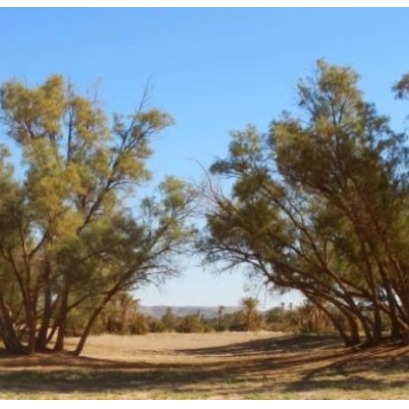
200 years ago they planted thousands of trees to stop river erosion: today they realized they were wrong
The introduction of this tree to the western US to combat river erosion backfired, displacing native species and disrupting fragile ecosystems. When talking about ecological restoration, planting trees often seems like one of the most obvious solutions to recover a degraded landscape. However, in fragile ecosystems, an intervention intended to help can end up generating new problems if the relationships between species, water and soil are not taken into account.
That happened with the tamarisk tree, a plant that for decades was considered an ally in some arid areas of the western United States. Introduced primarily during the 19th and early 20th centuries, this species seemed to have all the characteristics necessary to combat river erosion. It resisted high temperatures, tolerated saline soils and could grow in places where other plants had difficulty surviving. They planted trees to save rivers and ruined ecosystems. At first, the presence of this tree seemed beneficial. Their roots helped stabilize river banks and protect vulnerable land. But as time went by, the tamarisk began to expand rapidly and occupy large sectors of the banks, displacing native species such as poplars and willows that were historically part of those ecosystems. The problem was not only the arrival of this tree, but the conditions of the rivers where it managed to thrive. During the 20th century, many waterways in the American West were transformed by the construction of dams, water abstraction, and modification of natural flood cycles. According to research by the United States Geological Survey (USGS), these changes altered environmental conditions and favored the tamarisk over several native species that depended on natural river floods to regenerate. Trees to stop erosion: the unusual mistake of the United States 200 years ago For years, this tree was identified as one of the main causes of water loss in arid areas. That idea fueled campaigns to eliminate it with the argument that its disappearance would allow water resources to be recovered for ecosystems, agriculture and cities. However, later studies showed that the relationship between tamarisk and water consumption was much more complex than initially believed. In 2001, American authorities began using a biological control method by releasing the tamarisk leaf beetle. The result once again demonstrated that ecosystems do not function as a simple equation. The beetle managed to spread through different regions of the southwest of the United States and northern Mexico, reducing the coverage of the tamarisk in some sectors. But scientists are still studying its long-term consequences, since any species introduced to control another can generate new, unexpected effects. This insect was chosen because it feeds on the tree and could reduce its growth without depending exclusively on heavy machinery or chemicals.