The tallest sword tree in Asia was hidden in a fog forest: it is 84 meters and almost a thousand years old
It had been among the clouds for centuries. A laser scanner, 372 volunteers on the internet and a dizzying climb have identified the tallest sword tree in East Asia: 84 meters and almost a thousand years old.
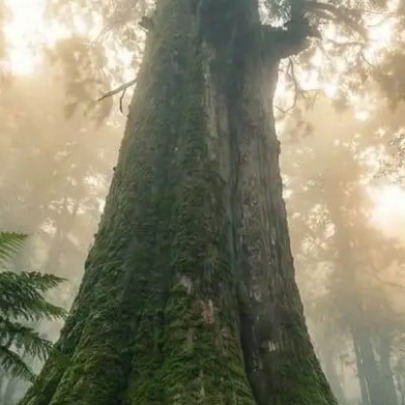
In the Sheshan mountain range, 1,656 meters above sea level in Taiwan, the tallest tree known in East Asia now grows. It has been there between 800 and 1,000 years. No one had measured it precisely. Rebecca Chia-Chun Hsus team, from the Taiwan Forestry Research Institute, has published in Frontiers in Forests and Global Change the story of how they found it: 84.1 meters of sword tree (Taiwania cryptomerioides) that the best available scanner could not measure in its entirety from the air. The paradox is that Taiwan is an island of 36,000 square kilometers. And the tallest tree in East Asia had been there for centuries. What was missing was not the tree, but the method to find and confirm it. An 84-meter needle in a haystack of 57,000 candidatesThe first phase of the work was aerial. An airborne LiDAR scanner, which emits laser pulses from the aircraft and calculates the distance to each obstacle with a vertical accuracy of less than 15 centimeters, generated a complete map of the height of the Taiwanese forest canopies. The result was a list of 57,065 trees with an estimated height greater than 65 meters. An amount impossible to verify one by one with field climbs. To reduce that universe, the team turned to citizen science. 372 online volunteers evaluated tree silhouette profiles on a web platform and together narrowed down the candidates from 57,065 to 4,736, eliminating 92% of the manual verification work required. A collective filtering system that forest ecology rarely uses and that, in this case, has proven to be statistically sound: the correlation between LiDAR estimates and subsequent direct measurements showed an R²=0.86 with an average error of 4.55 meters. LiDAR transforms months of field exploration into days of data processing. The problem is that the haystack of candidates was still enormous. Citizen science was the way to reduce it without losing rigor. The sword tree that the scanner could not see in its entirety Since 2014, the team has been climbing trees. In total, 22 specimens of more than 40 meters have climbed to the top, all on terrain with average slopes of 40 degrees and at altitudes between 1,500 and 2,500 meters. Nineteen of the 22 were Taiwania cryptomerioides. On those climbs they learned something that would change the outcome of the study. LiDAR underestimates the height of the most extreme trees. When the crown is very dense and the slope of the terrain is steep, the laser pulses do not penetrate to the highest point of the tree: the crown itself blocks them. In the tree that would end up being the record, the difference was 4.6 meters: the scanner estimated 79.5 meters; the tape measure from the cup confirmed 84.1. The tree was even taller than the data had suggested. The discovery confirms that the record specimen is a Taiwania cryptomerioides with a trunk several meters in diameter, located in the Sheshan mountain range at 1,656 meters above sea level. The ten trees taller than 70 meters identified in the study are all Taiwania, without exception. The species dominates the cloud forests of Taiwan at these altitudes not by chance, but because it has been adapted for millennia to a microclimate that combines constant humidity, moderate temperatures and deep soils. The scanner is precise. Not infallible. For extreme giants, climbing remains the gold standard. Eight Hundred Years in the Clouds Extrapolating the diameter of the trunk puts the age of the record tree at between 800 and 1,000 years, a figure obtained from documented growth rates of the species. The team did not carry out direct dating using dendrochronological coves, so the margin of error is wide. It may be exact. It may not be for several decades in any direction. What is not in dispute is the ecosystem that has made it possible. Taiwans montane cloud forests, between 1,500 and 2,500 meters above sea level, maintain almost constant air humidity throughout the year thanks to the interaction between Pacific maritime winds and the islands orography. *In these conditions, the Taiwania grow without the prolonged interruptions that in other climates would stop their vertical development for decades.* The result is forests where 941 trees exceed 65 meters and where ten of them exceed 70. The record that could still fallIt is important to be precise about what this study states and what it does not. "The tallest known sword tree in East Asia" is the correct name, and the geographical limitation matters: the forests of Borneo, the jungles of northeastern India or the slopes of the Himalayas have not been scanned with this pulse density or validated by systematic field climbs. There may be taller trees in Asia that do not yet have a tape measure raised to the top. The record is provisional by design, not by oversight. The tool already exists. Forests that have not yet been mapped with this resolution as well. What remains now is to decide which haystack to point the scanner at. The team has made the interactive map publicly available at no1tree.tw and has documented the methodological pipeline in enough detail to make it replicable outside of Taiwan. The question that the study leaves open is not whether the Sheshan tree is the tallest in Taiwan, but whether the same method applied to the tropical forests of Southeast Asia or the mountain ranges of the Indian subcontinent would find candidates that surpass it. If the answer is yes, the record has an expiration date.