FEDEMAD 2026: wood, innovation and sustainable development in the Chubut mountain range.
The second edition of the Wood Fair will be held on September 11 and 12 in Esquel, with an agenda focused on fire prevention, wood construction, use of construction systems, biomass heating and strengthening the forest-industrial chain.
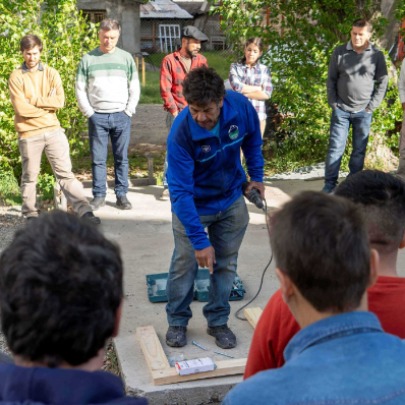
The Wood Fair (FEDEMAD) was born as an initiative aimed at strengthening the coordination between the public and private sectors linked to the forest-industrial chain. Its first edition, held in 2024 in the city of Esquel, brought together about 300 people and more than 20 local and national companies, consolidating itself as a meeting space for producers, professionals, educational institutions, public organizations and companies in the sector. The 2026 edition will be based at the facilities of the Esquel Rural Society and will feature specialized conferences, technical exchange spaces, training and a wide sample of exhibitors. The organization is in charge of the Industrial Forestry Commission of the Regional Development Agency (ADRE) of Esquel and the Andean Region. Part of this space are science and technical organizations such as INTA, CIEFAP and the National University of Patagonia San Juan Bosco, educational institutions such as ISET 815, Esc Politecnica 701, CFP 655 and CFP 660, Municipality of Esquel, Municipality of Trevelin, provincial and national organizations, professional associations, and representatives of the private sector. Training and value addition Esquel and the region have an important history in training and education linked to wood construction and the forestry sector. Among the educational proposals, the Wood Construction course of the Higher Institute of Technical Education (ISET No. 815) stands out, the carpentry and construction courses taught by the vocational training centers of Esquel and Trevelin, and the Forestry Engineering course taught at the mountain headquarters of the National University of Patagonia San Juan Bosco. Gustavo Salvador, a reference for INTA Esquel and a member of the organization, announced that one of the main thematic axes will be the prevention of fires in the urban-forest interface and wood construction. The agenda will include two international virtual conferences, one by the United States Forest Service and the other by the Pau Costa Foundation of Catalonia, and a specific workshop with references from the region. There will also be a block dedicated to wood construction systems, where CONICET specialists will present experiences linked to the use of Ponderosa Pine, along with builders from different regions of the country who will share their experiences, application cases and business model. Another of the highlighted topics will be efficient heating and energy use of biomass, with exhibitions on high-performance stoves, thermal inertia systems and the use of pellets in different types of buildings. In addition, the program includes a round table with national and provincial authorities and representatives of business chambers where the opportunities and challenges of the sector will be discussed, live demonstrations, and a competition for wood products aimed at making visible the innovative potential of the sector. It is a space to make the sector visible, where we can articulate, generate new business, train ourselves, share experiences and innovations, highlighted Salvador.Sustainable management of forests One of the objectives of FEDEMAD is to promote the sustainable use of native and established forests, valuing forest management as a tool for fire prevention and regional economic development. In this sense, Salvador pointed out that in Chubut there are around 35 thousand forested hectares that require management tasks such as pruning and thinning. These activities are important to reduce the risk of fire and also generate matter that can be used as bioenergy and products for the construction sector. In Chubut, about 80% of the wood for construction comes from the Northeast of Argentina, so we have the possibility of working in a local market with many possibilities for expansion. And he further added: Although wood is a traditional material that has been used throughout history, there is currently a resurgence of construction with that material worldwide due to its high potential to reduce greenhouse gases and its low carbon footprint. Wood construction has evolved extraordinarily in recent decades. Today we have classified structural wood, engineering products such as glued laminated wood and cross-laminated panels (CLT), as well as calculation and design standards that allow the construction of increasingly taller and safer buildings. Wood does not represent a return to the past; It represents a way of building the future. It is a renewable material, stores carbon, improves the energy efficiency of homes and generates local development. Patagonia has the resources, technical knowledge and capabilities to become a national benchmark in sustainable construction. The challenge now is to work in an articulated manner to transform that potential into more employment, more innovation and truly sustainable development, concluded the INTA Esquel specialist.