How protecting forests can guarantee drinking water for generations to come
Experts propose forest management inspired by nature so that the basins function as reserves and do not lose the key role in their filtration and storage
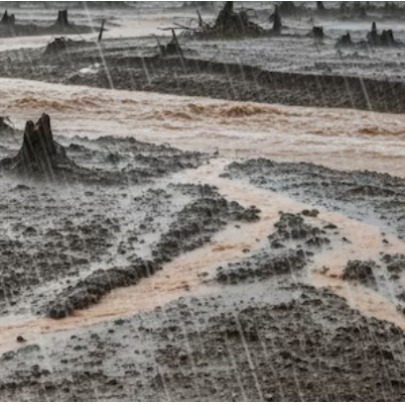
Deforestation negatively impacts the capacity of hydrographic basins to retain and filter water, increasing the presence of young water and the contamination of water sources for human consumption. A study from the University of British Columbia highlights that the loss of forests deteriorates the global water cycle and threatens water quality, according to The Conversation. Deforestation reduces the spongy action of basins: rainwater reaches rivers and streams more quickly, without enough time to filter into the soil, which leads to greater carryover of pollutants. This directly affects the quality of water intended for the population. For every 1% of forest lost, the percentage of young water in river flows increases by around 0.17%, according to research led by Adam Wei. Young water is that which comes from recent rainfall, generally from the last two or three months. Its increase indicates that basins lose their natural ability to store and purify water efficiently.How deforestation alters water qualityResearch published in The Conversation explains that, by removing the forest canopy, raindrops impact the soil with greater violence. Additionally, compaction caused by machinery and access roads reduces the soils filtration capacity, forcing surface runoff. Without enough trees, the transpiration process necessary to return water to the atmosphere is lost. The soil, when saturated, can no longer store water; When it rains again, the excess is quickly directed to surface courses, accentuating the proportion of young water in rivers and streams. These effects are aggravated in basins with shallow groundwater and soils with low storage capacity, where any rapid alteration in vegetation cover translates into immediate changes in the flow and quality of water. Forest management to protect watershedsThe team from the University of British Columbia found that the impact of deforestation depends so much on the area total removed as from the spatial pattern of forest patches. The spatial configuration of trees matters as much as the total area lost, highlighted the study reported by The Conversation. The edges of the forest, or contact zones between trees and clearings, play an unexpected role: increasing their density can decrease the proportion of young water. This occurs because at the edges, exposure to the sun and wind stimulates evapotranspiration, reducing the volume of runoff. The effect is more noticeable in landscapes where forest cover is less than 40%. There, sufficiently large openings favor lateral light penetration and evaporation. On the other hand, fragmenting dense forests into small clearings reduces the effectiveness of this regulatory mechanism. According to The Conversation, the recommendation is to avoid homogeneous cuts and apply techniques that imitate natural diversity, such as selective logging and continuous cover forestry. Thus, the negative effects of forest exploitation on water quality are reduced. The results of this study reinforce the central importance of forests in the management of water resources. Designing forest systems inspired by natural structure will allow watersheds to function as efficient water reserves, instead of becoming channels where pollution circulates uncontrollably. The research highlights that forest management must be adapted to the specific characteristics of each watershed. Considering the topography, soil type and rainfall regime is essential to maintain ecological balance and ensure the availability of clean water. Virus free.www.avg.com