AI wood identification: a new frontier for industrial traceability
Introduction
Pressure on the forest-products chain is no longer focused only on producing more, faster, and with better finishing quality. In many markets, the critical question now starts earlier: how to verify quickly that a piece of timber is actually the declared species and that its documentary path can withstand audits, inspections, and increasingly detailed regulatory demands. In that context, a paper published on June 9, 2026 on arXiv makes a once narrow line of work look newly relevant to mainstream industry: AI-assisted macroscopic wood-species identification.
The study, focused on five species in the Philippines, shows that wood scientists without a programming profile were able to build and deploy operational classification models from cross-section images. Beyond the specific case, the broader signal is strong for the entire sector. Species identification is starting to move out of a purely expert domain and into environments where speed, repeatability, and integration into real checkpoints matter, from warehouses and ports to processing plants and inspection stations.
Technical development
What makes the publication significant is not only that it uses AI, but how it uses it. The work starts from a long-standing industry problem: anatomical wood identification requires specialist knowledge, time, and often laboratory access or equipment that is not available at every control point. That limitation reduces verification scale and creates grey areas between commercial declaration, physical inspection, and expert confirmation.
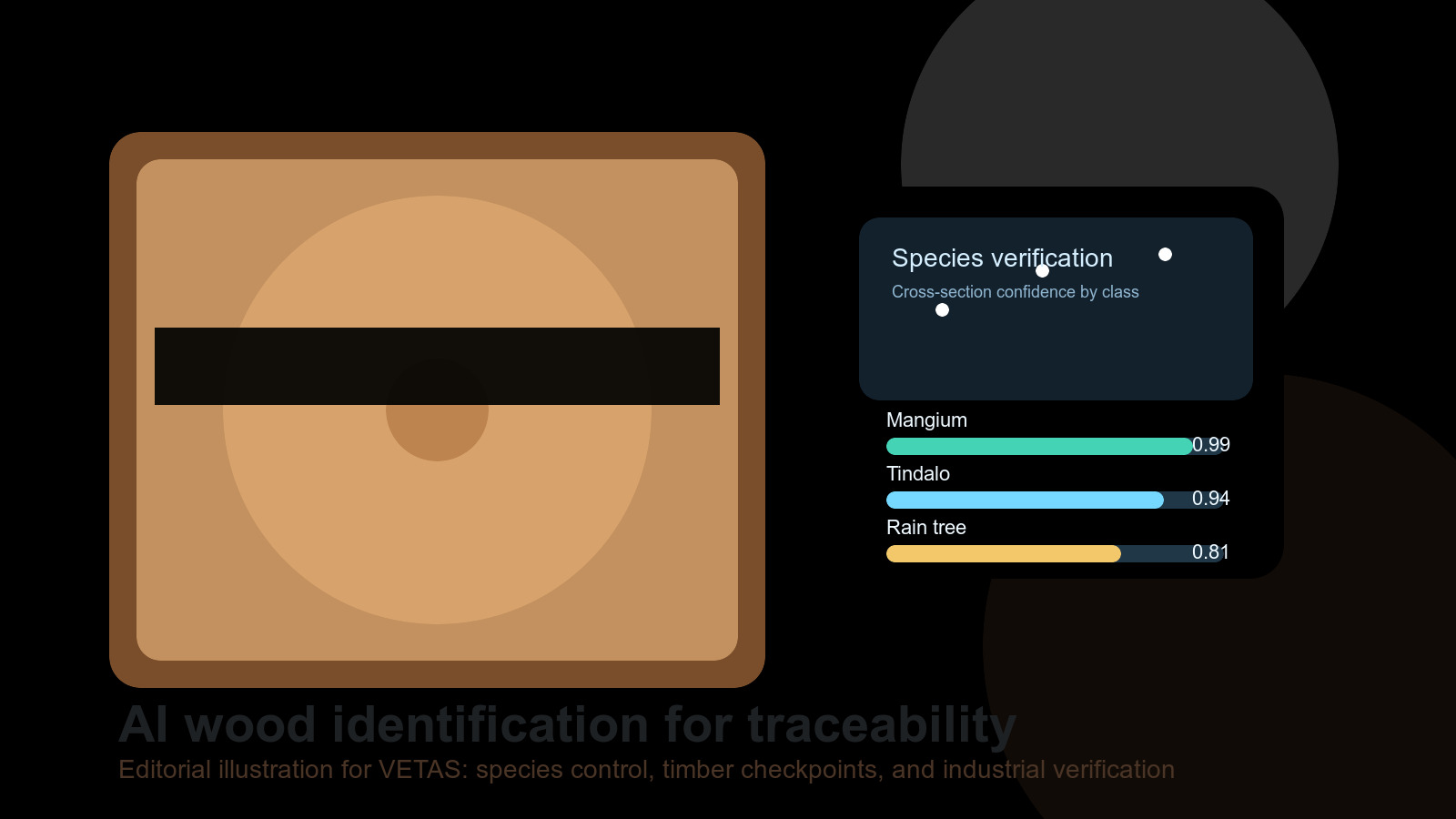
According to the abstract, the researchers worked with 10,663 verified images from 260 specimens and evaluated binary classifiers for five commercially relevant hardwoods. Four of the five species achieved AA-grade performance in the reported metrics, while one fell short in average precision because of a very small positive test set. Even so, the overall result points to a system capable of ranking probabilities quickly and flagging when a sample deserves a second level of review.
That distinction matters. The industrial promise of these systems is not that they immediately replace laboratory verification. It is that they can reorganize the control pyramid. A visual system trained on a strong dataset can operate as a first operational barrier: it filters samples, prioritizes inspections, reduces dead time, and improves the consistency of preliminary screening. Instead of reviewing everything with the same intensity, a company or authority can focus scarce resources on doubtful or high-risk cases.
From a process perspective, this fits a wider manufacturing trend: pushing intelligence closer to the operational edge. Just as machine vision is used for surface inspection and sensors are used for predictive maintenance, AI-assisted wood identification seeks to place a useful decision where material is physically moving. In timber operations, that can mean validating batches at plant intake, reinforcing export traceability, comparing supplier declarations with receiving controls, or supporting stronger chain-of-custody routines in products with stricter documentation requirements.
There is also a workforce and deployment angle. If a system can be used by technical staff who are not programmers, the adoption threshold drops significantly. The conversation no longer belongs only to data-science teams. It begins to involve quality managers, technical buyers, internal labs, trade associations, and control agencies. At that point, the challenge shifts toward sample quality, photographic protocol, dataset curation, and model governance.
Industry impact
For the wood and furniture industry, the news touches several fronts at once. The first is traceability. In a market where origin, legality, material composition, and documentary backing are under closer scrutiny, faster species validation can become a concrete operational advantage. That is not relevant only to exporters or large groups. It also matters to sawmills, importers, processors, and manufacturers that need to reduce purchasing risk or demonstrate consistency to customers and certifiers.
The second front is economic. When identification depends only on scarce specialists and slow workflows, the cost of control rises and the frequency of checking falls. If part of the task can be handled through standardized image capture and well-trained models, an intermediate layer becomes far more scalable. That does not eliminate infrastructure or maintenance costs, but it changes the balance between controlled volume and available expert hours.
There is also a less visible commercial consequence. Traceability is no longer only a defensive requirement aimed at avoiding legal problems. In higher-value segments, it is becoming part of the industry's commercial language. The ability to demonstrate origin, consistency, and input control does more than reduce contingencies. It can improve a supplier's position with buyers comparing risk, reputation, and documentary responsiveness.
Recent research on machine learning to detect harvest-location misrepresentation had already pushed this agenda in other parts of the chain. What the new paper adds is another layer: a more accessible anatomy-based recognition approach and a workflow usable by wood specialists without coding. That combination could accelerate field testing in regions where the bottleneck is not lack of interest, but lack of workable tools.
Trends and future
The first clear trend is that forest-product traceability is moving toward a multimodal system. Documentation, certification, logistics data, and material analysis are increasingly likely to coexist. One paper, one label, or one declaration will not be enough. Verification will rely on cross-checking layers, and image-based identification may become one of those contrast layers.
The second trend is the partial democratization of technical control. Partial, because strong expertise will still be needed to train, audit, and correct models. But democratization nonetheless, because the tool brings analytical capacity closer to users who previously could only escalate doubts and wait for an external answer. In markets under growing regulatory pressure, that agility may define whether a process becomes more trustworthy or simply slower.
The third trend concerns training and labor. If species control starts to incorporate standardized capture, probability reading, and escalation criteria, operational profiles will also change. There will be more demand for technicians able to combine wood knowledge, process discipline, and digital literacy. This is not a replacement for traditional skills. It is an expansion of them.
Finally, there is a question of industrial maturity. AI in wood processing has already shown value in surface inspection, defect classification, and line optimization. The novelty of this new work is that it pushes AI toward a more sensitive field: the material truth of the input itself. When a tool helps answer what wood actually is, not only how it looks on the surface, the potential impact moves to a higher level.
Editorial close
The June 9, 2026 publication should not be read as an isolated academic curiosity. What it reveals is that timber traceability is entering a more operational and less declarative phase. The industry does not only need compliant paperwork. It needs instruments capable of checking, within practical timeframes, whether what is moving through the chain matches what is being declared.
For VETAS readers, the conclusion is direct. The next major debate in the wood chain will not revolve only around productivity, design, or better-performing materials. It will also revolve around the ability to verify. In that field, the combination of anatomical knowledge, computer vision, and field-level technical adoption could become one of the most influential innovations of the coming years.