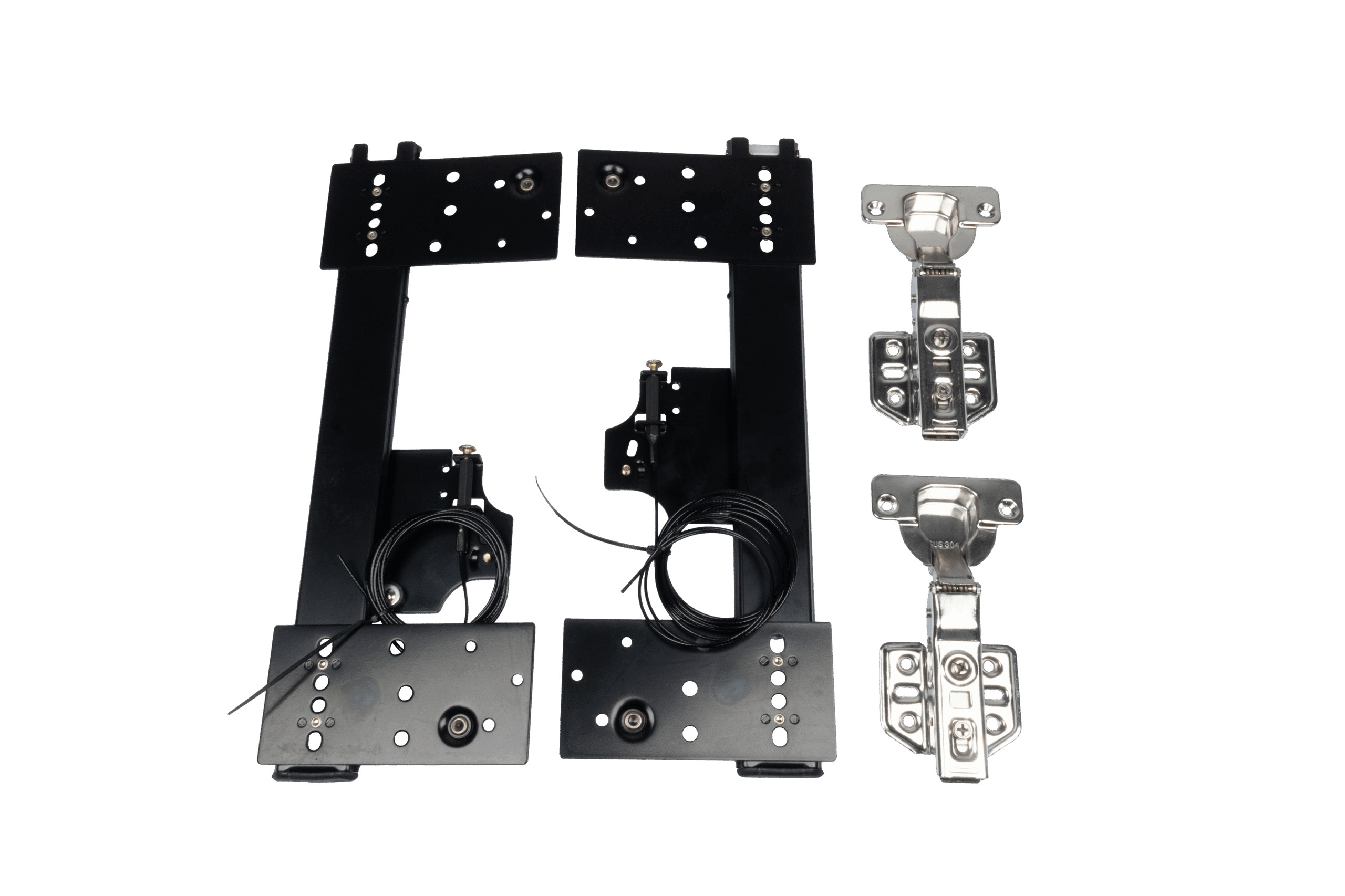

ALCE Pocket Sliding System: concealed doors with an industrial logic
In furniture, closets and interior partitions, the detail that users notice most is often not the material-it is the experience. A door that rattles, slams, binds or leaves uneven reveals can undermine an otherwise flawless façade. That is why "pocket" sliding systems have been gaining traction: the door leaf slides and then hides inside a cavity ("pocket"), freeing the front and enabling a clean aesthetic with hardware kept out of sight. In the Argentine market, ALCE Herrajes includes a Pocket Sliding System in its catalog, aimed at delivering that concealed-door effect with controlled mechanical behavior.
What "pocket" really means-and why it is different from a regular slider
A classic sliding door usually works "in plain view": track, hangers and, in many cases, bottom guidance remain exposed or only partially concealed. A pocket system is designed so that, when open, the door leaf leaves the front plane and nests inside an internal volume. That single change drives several engineering consequences:
- Tighter installation tolerances: the pocket needs controlled clearances so the leaf does not rub on edges, fasteners, or warped panels.
- More demanding guidance: the door must stay stable even while part of it is inside the cavity, where lateral loads and torsional effects are more pronounced.
- Higher sensitivity to rolling quality: if the hanger/roller system is mediocre, a pocket door feels heavy, noisy or inconsistent.
ALCE's Pocket Sliding System is best understood as an enabling solution for this "concealed" application-an increasingly requested feature in interior cabinetry, wardrobes and architectural millwork.
The technical core: track, hangers and guidance (where experience is won or lost)
Without making claims that depend on a specific model configuration, pocket doors consistently succeed or fail in three technical zones:
1) Track + hangers: friction, load paths and stability
The track-and-hanger assembly is the heart of the system. Modern pocket solutions typically target:
- Low-friction rolling for smooth motion (ideally with stable rolling surfaces and protected bearings).
- Rigidity to minimize track deflection and micro-oscillations that translate into noise and wear.
- Adjustability (height and/or plumb) to compensate for real-world deviations in cabinetry and construction. A millimeter of slope can become a permanent rub point if there is no adjustment range.
From a manufacturing standpoint, these features reduce callbacks and make installation more repeatable across different jobsite conditions-walls that are not perfectly straight, cabinets that settle, or wood-based panels that move with humidity.
2) Bottom guidance: the anti-sway "insurance policy"
Bottom guidance prevents the leaf from yawing away from the plane during operation. In pocket applications, it matters even more because the door is entering a confined space. The most effective designs use discreet, low-friction guides with fine adjustment. The goal is not to slow the door down; it is to control its degrees of freedom so the leaf travels predictably and stays centered.
3) End-of-travel control: impacts, noise and service life
The most punishing moments are at closing (and sometimes at opening). Soft-close damping-well documented across pocket-door hardware families-aims to reduce speed before the door reaches the end stop, avoiding slam impacts and protecting components. In residential and contract settings, the benefit is not just "premium feel": it is also durability (less fatigue on screws, track, stops) and safety (fewer pinch and impact events).
Industrial impact: more design freedom, less visible hardware
The furniture and interior woodworking industry is pulled by two forces at once:
- Functional minimalism: cleaner fronts, fewer handles, fewer visible elements.
- High-cycle usage: kitchens, wardrobes and offices demand mechanisms that remain consistent over thousands of cycles.
Pocket systems sit right at that intersection. They allow doors to disappear without compromising access. For manufacturers, this becomes a concrete way to differentiate premium and custom lines with a technical feature-not merely a styling cue.
Use cases where pocket systems justify their engineering
- Kitchen wall units and tall cabinets: hiding appliances or work zones; open, use, and clear the front again.
- Closets and dressing rooms: doors that do not intrude into circulation and keep sight lines open.
- Home office cabinetry: concealing printers, small racks, or charging stations.
- Light interior partitions: projects where every centimeter matters and a swing door is impractical.
Trends and what comes next: from "hardware" to "system"
Pocket solutions keep evolving toward deeper integration: bi-directional damping (soft open and soft close), synchronized leaves, drilling templates to reduce installation errors, and compatibility with thinner panels to lighten assemblies. Maintenance is also becoming a design requirement-systems that can be cleaned or serviced without dismantling an entire cabinet are a major advantage in commercial interiors.
The industrial message is clear: hardware is no longer "an accessory." It becomes a measurable system-geometry, tolerances, guidance and controlled stopping. In that context, ALCE's Pocket Sliding System aligns with what the market is increasingly demanding: solutions that solve aesthetics, ergonomics and reliability at the same time.
Editorial close
When a door disappears and the user only perceives silence and smoothness, the credit goes to engineering discipline: kinematics, clearances, guidance and end-of-travel control. Pocket systems ask more from designers and installers, but they return a superior experience and a cleaner front that stays that way over time. ALCE's Pocket Sliding System fits into that trend-hardware designed for furniture that feels contemporary not only in how it looks, but in how it works.