
MDF without pre-drilling: when a screw becomes a process tool
In MDF furniture and cabinetry, one operation looks minor but often determines the outcome: fastening one panel to another without blowing out the edge, without stripping the fibers, without opening the corner, and while holding squareness during assembly. The industry knows the pattern well: MDF is stable and easy to machine, but its edges concentrate risk. A poorly chosen screw-or the wrong geometry for the substrate-can turn a simple joint into a recurring rework point.
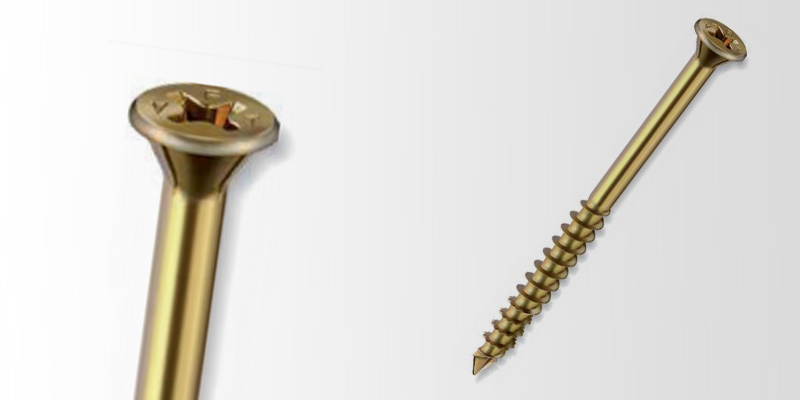
Vialro (Laurutis Hnos.), based in Valentín Alsina and tracing its industrial roots back to 1961, manufactures screws and develops product lines aimed at specific use cases. Within its Dry Madera line, the company offers Vialro F-CUT, described as a screw intended to precisely fasten MDF-to-MDF intersections without pre-drilling, also suitable for carpentry, wood structures, furniture, and combinations such as melamine/wood and MDF/MDF.
The technical point is that a screw like F-CUT is not just a "consumable". When designed for the substrate, it changes the process: fewer steps, less variability, better repeatability, and fewer downstream problems.
1) Why MDF needs a different fastening approach
Unlike solid wood, MDF has a homogeneous fiber structure with no grain, and it offers good dimensional stability. That homogeneity is an advantage for faces and machining, but MDF edges introduce specific challenges:
- Less long-fiber anchoring: threads can bite, but they can also crumble if geometry is mismatched.
- Edge blow-out risk when driving near the border, especially if the tip aggressively wedges material apart.
- Sensitivity to over-torque: excessive tightening strips the substrate and reduces holding capacity.
That is why, in scalable production, the screw becomes a process variable rather than a trivial hardware choice.
2) The F-CUT concept: precision without pre-drilling (still requires method)
In Vialro's public description, F-CUT is "ideal for precisely fastening MDF panel intersections without prior drilling". That maps to two immediate industrial benefits:
- Time savings: eliminating pre-drilling removes an operation and setup time.
- Fewer failure modes: off-center or wrong-diameter pilot holes lead to misalignment and edge damage; removing the step simplifies the workflow.
However, "no pre-drilling" does not mean "no control". A screw designed for this use relies on its geometry (tip design, thread profile, lead characteristics) to create a stable path in MDF without tearing it apart. The discipline remains: correct driver speed and torque, good bit condition, and proper length/diameter selection for the panel thickness and joint design.
3) Finish and durability: surface treatment also matters
Vialro specifies a yellow zinc-plated finish for F-CUT. Technically, surface treatments play two roles:
- Corrosion protection for interior environments with intermittent humidity (kitchens, laundries, closets).
- Friction behavior during driving, supporting more consistent advancement and reduced risk of abrupt torque peaks.
In fasteners, friction is part of the system: it affects required torque, the "closing feel", and the likelihood of over-tightening. Finishes are therefore not just cosmetic.
4) Furniture use cases: where the difference becomes obvious
F-CUT becomes relevant in joint types where MDF frequently fails at the process level:
- Drawer units and modular boxes: repeated intersections where seconds per joint define productivity.
- Melamine furniture built on MDF/particleboard cores: hidden internal fasteners still define stiffness.
- Frames and structural rails: when you need rigidity without additional complex hardware.
- On-site repairs and adjustments: where pre-drilling is inconvenient and mistakes are costly.
In these scenarios, a substrate-appropriate screw reduces surprises: fewer split edges, fewer rebuilds, less scrap.
5) Industrial impact: less rework, more repeatability (the real gain)
In manufacturing, the cost of fastening is rarely the screw price. It is:
- Panels that crack and must be remade.
- Extra minutes per joint (pilot holes, alignment, corrections).
- Operator-to-operator variation (some teams get it right, others struggle).
- Field issues: looseness or structural failures over time.
When the fastener is aligned with the material, the assembly process stabilizes. That stability is one of the most valuable "inputs" for a growing workshop or factory: it enables accurate planning, standardized quality, and less dependence on the single best craftsperson.
6) Trends: longer wood-structure screws, SIP/wood frame, and rising standards
Wood fasteners are also evolving beyond furniture. In timber construction ecosystems (wood frame, SIP panels), longer screws and more demanding standards are increasingly relevant. A sector note highlights Vialro's development of a dedicated line for SIP and wood frame assembly, tailored with market references and aligned with IRAM requirements.
While F-CUT sits closer to cabinetry and shop work, it shares the same principle: design the fastener for the system (material + application), not the other way around. The broader trend is specialization as a way to reduce improvisation and increase reliability.
Editorial close
In MDF, a reliable joint depends on more than clamps and squares-it depends on fastening decisions. A substrate-focused screw can eliminate steps, avoid typical failure modes, and turn fragile assembly into a repeatable process. Vialro F-CUT embodies that applied-engineering logic: a small component that, when properly specified and used with method, improves both productivity and the final feel of furniture.