
Turning "waste" into product: shavings, drying, and biomass process heat
Industrial wood processing lives with a constant paradox: the more efficient the primary sawing, the more important the leftovers become. Slabs, low-grade logs, undersized timber, screening fines, and dust are not a minor accounting detail-they shape the true cost per usable cubic meter. At the same time, markets increasingly reward mills that close loops: animal bedding, absorbent substrates, biomass heat, and packaged products with consistent quality. At that intersection-material utilization plus process control-sits a technology that often feels "upstream" from furniture, yet strongly affects the sector's supply chain: wood shaving production plants and their drying/energy systems.
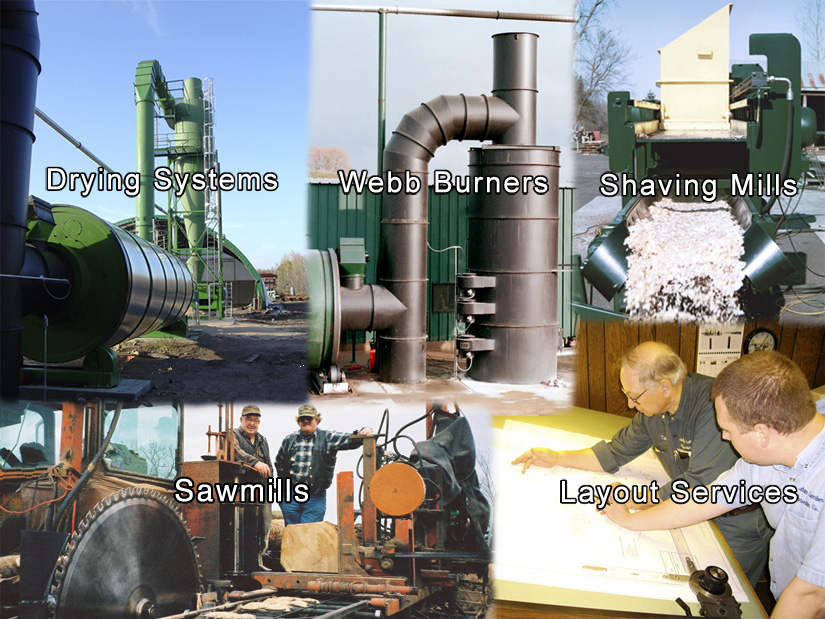
Jackson Lumber Harvester Co., Inc. manufactures sawmill-related equipment in the United States and is widely associated with a specific cluster of solutions: Jackson Wood Shaving Mills, integrated drying systems, and Webb® biomass burners. The technical interest for the wood industry is that these are not isolated machines; they form a plant-level architecture that turns low-value wood fractions into an industrial product with defined behavior.
1) Shavings as a product: geometry, bulk density, and cleanliness
Jackson describes its Wood Shaving Mill as producing shavings similar to the by-product from a planer, and it provides typical "green" bulk-density ranges for loose shavings. Beyond the figure, the key point is the product definition. In bedding applications, for instance, three technical variables drive performance:
- Shaving geometry: curly, fluffy material maximizes volume, absorption, and animal comfort.
- Consistency: abrupt changes in particle size or a heavy fines fraction change how the product performs.
- Contamination control: bark, grit, and foreign objects reduce quality and increase downstream packaging risk.
The system is designed to accept challenging raw material streams-pulpwood, low-grade logs, slabs, and similar waste wood-within practical feeding constraints. In industrial terms, that means a mill can monetize wood that would otherwise be discounted heavily.
2) Uptime engineering: knives, quick changeovers, and durable structure
The least visible part of a shaving plant is what determines whether the economics work: effective operating hours. Jackson emphasizes design choices for continuous production (multiple shifts) over long lifetimes. In that context, knife management is central: slow knife changes turn into expensive downtime.
The "knife cartridge" approach is an uptime strategy. Instead of a long in-place rework, a prepared cartridge is swapped in, and sharpening/setting is handled off-line. Industrially, this reduces lost production time and helps stabilize output quality.
Jackson also describes modular multi-box arrangements for larger capacities-an architectural choice that allows one section to be stopped for knife work while other boxes continue running. That concept (avoiding full-plant stoppage) is typical of mature continuous processes.
3) Drying: once you bag shavings, water becomes the main constraint
The sector's practical turning point was the shift from bulk "green" distribution to bagged shavings. The reason is simple: wet shavings mold in bags, killing product value. Jackson's historical narrative reflects the industry's search for drying approaches, eventually converging on rotary drum drying as an industrial solution.
From a process standpoint, drying shavings is demanding: the material is light, insulating, and can be combustible. That forces careful control of temperature, gas flow, and safety systems-and it also requires well-designed integration between the burner and the dryer.
4) Webb Burner®: process heat from dry biomass fuel
To close the loop, Jackson manufactures (with historical cooperation tied to William B. Webb) the Webb Burner® Biomass Solid Fuel Combustion Systems. Public technical descriptions position the burner as a cyclonic/suspension combustion system capable of rapid response to load changes, with stated sizes from 1 to 60 million BTU/hr. The crucial constraint is fuel condition: moisture must be low (under roughly 15%), and particle size should be small (commonly "¼-inch minus").
That requirement is not arbitrary. It defines the fast-combustion regime and the dynamic response the burner is designed for. When a plant has access to dry byproduct (dust, fines, pelletized material), the industrial advantage is clear:
- Lower heat cost than fossil fuel in many cases, directly affecting cost per dry yard/ton.
- Waste-to-energy integration: fuel is generated by the process itself, reducing disposal.
Jackson's materials also reference safety and compliance considerations (including NFPA 664 and NFPA 85 in relation to controls), which matter in any operation handling wood dust and combustion systems.
5) Why this matters to the wider wood and furniture industry
Even if a furniture shop is not producing shavings as a product, this technology impacts the ecosystem in three ways:
- Better whole-log utilization at sawmills and wood plants, improving overall economics and stabilizing supply.
- Thermal energy for wood processes: drying systems and plant utilities benefit from integrated biomass heat.
- Standardized byproducts: bedding and biomass become specified products rather than "whatever is left".
Under cost pressure and sustainability expectations, converting low-value fractions into stable output streams is a systemic advantage.
6) Trends ahead: modular growth, safety integration, and service as part of ROI
The near-term future of these plants is not defined only by "bigger throughput". It is shaped by:
- Modular architectures that scale without full shutdowns.
- Deeper controls and safety integration (spark detection/extinguishing, remote monitoring, automation).
- Aftermarket support-manuals, parts, field service-because continuity is part of the investment case.
Jackson's support materials emphasize parts availability, operator manuals, and field service even for older equipment-an important reality in industries where machines run for decades.
Editorial close
The wood industry is increasingly competing not only on what it cuts, but on what it fully utilizes. A well-designed shaving plant-paired with drying and integrated biomass heat-is a concrete way to turn "waste" into product and risk into a controlled process. When the system is treated as an architecture (shaving mill + quick maintenance + drying + burner + controls), the outcome is not just shavings: it is a stable industrial stream with value-added logic and circular-economy pragmatism.