
Decorative panels as industrial "skin": melamine and wood veneer
There is a moment when a piece of furniture stops being "a set of boards" and becomes an object. That shift is not always about the volume or the joinery-it is often about the skin: texture, tone, gloss level, and the way a surface behaves under light and daily use. For furniture and interior fit-out, surface specification is no longer decoration. It is a technical decision that affects productivity, perceived quality, durability, and consistency across production batches.
This is where Enchapadora San Juan S.A. positions its offer. The Argentine company-active for more than 50 years-focuses on manufacturing decorative finishes for panel products using melamine and wood veneer, aimed at furniture and interior design applications. Their proposition is best understood not as "another color option", but as a system of industrializable surfaces organized into lines and collections-built to translate design intent into repeatable factory outcomes.
1) What a decorative panel is (and why it is more than "printed MDF")
In industrial terms, a decorative panel starts with a substrate (MDF or particleboard/MDP) and adds a surface layer (melamine or veneer) to deliver a controlled, final finish. The substrate dictates dimensional behavior, machinability, and structural response; the surface layer dictates appearance and how the panel resists wear in real use.
The advantage of an industrial surface is repeatability. When the finish is standardized at the material level, the shop reduces improvisation (late-stage staining, painting, emergency touch-ups) and gains a more predictable flow. In kitchens, closets, retail fixtures, and high-traffic interiors, that predictability becomes a competitive edge.
2) Melamine surfaces: engineered durability for volume production
Melamine-faced panels are not "just plastic film". They are typically built around a decorative paper impregnated with resins and pressed into a surface layer designed to perform under everyday conditions. From a technical perspective, performance is driven by:
- Scratch and abrasion behavior (dependent on formulation and process).
- Gloss stability: matte and semi-matte options that manage reflections.
- Cleaning resistance: stains, household chemicals, and micro-abrasion.
- Compatibility with edge banding (ABS/PVC/melamine) and adhesives.
For manufacturers, the value is straightforward: fewer finishing steps and a more consistent result. Quality becomes less dependent on "how the lacquer turned out today" and more dependent on a specified, controlled material.
3) Wood veneer: managed natural variation, authentic depth
Veneer delivers what printed decors try to emulate: the micro-variation of real wood grain. The industrial challenge is to manage that natural variability through selection, matching, tone control, and pressing processes that avoid defects such as bubbles, lifting, or surface marking.
For interior design, veneer adds visual depth and tactile authenticity. For production, it requires discipline: storage, handling, and tighter quality checks. When executed well, veneer offers identity and warmth at scale-without turning every project into a custom finishing job.
4) Enchapadora San Juan's collection logic: "Expresión Natural" as an example
Within the Expresión Natural line, Enchapadora San Juan organizes nature-inspired designs on MDF and MDP substrates. The collection includes references such as Roble Toscana and Roble Verona, alongside elms, walnuts, and other natural-looking surfaces. Technically, this collection approach helps specification: manufacturers don't buy "light brown", they choose a defined surface identity that can be repeated and combined.
That matters because it reduces friction between design and manufacturing. A studio can define a palette, and a factory can deliver it without reinventing the finish for every project. In oak-style decors, pore definition, grain rhythm, and micro-texture are essential for avoiding a flat look under grazing light.
5) Applications and use cases: kitchens, closets, retail, and interior paneling
Decorative panels are typically used where aesthetics and durability must coexist:
- Kitchens: fronts, visible interiors, appliance integration panels.
- Closets and dressing rooms: doors, partitions, visible shelving.
- Retail fixtures: counters and panels exposed to intensive use cycles.
- Interior fit-out: wall cladding, decorative paneling, built-in libraries.
In all these cases, panels are touched, cleaned, bumped, and expected to remain stable. Surface choices should therefore follow use criteria-not only color preference.
6) Industrial impact: less rework, more consistency, higher perceived quality
When a manufacturer adopts collection-based decorative panels, three operational improvements are common:
- Less rework: fewer finishing operations and fewer job-site touch-ups.
- Shorter lead times: materials arrive ready for cutting, machining, and edging.
- Higher perceived quality: controlled textures and matte levels "feel premium" instantly.
Consistency across fronts, sides, and edges also helps deliver a unified object. In a showroom, that coherence is often the difference between furniture that looks "assembled from boards" and furniture that reads as a designed piece.
7) Trends ahead: realistic textures, deep mattes, and surfaces that work with light
Market direction is clear:
- More realistic textures, with deeper pore and grain cues.
- Matte and semi-matte finishes to manage reflections in modern interiors.
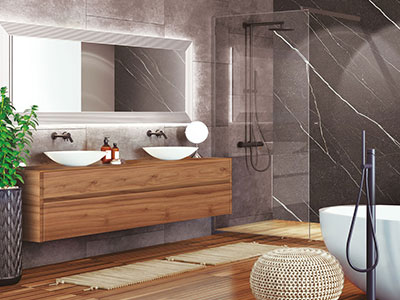
- Multi-material palettes combining wood, stone/oxide looks, and solids in one space.
Enchapadora San Juan explicitly positions itself around continuous design renewal, European trend alignment, and ongoing plant technology updates-relevant signals in a category where surface fashion evolves steadily and influences purchasing decisions across entire projects.
Editorial close
In fast-cycle manufacturing, surfaces have become an industrial language. A well-engineered decorative panel helps companies produce faster, with less variation, and with a level of quality customers perceive without explanation. Wood-whether through melamine decor or real veneer-returns as technical material: gloss control, tactile response, cleaning behavior, dimensional stability, and design coherence. That is the practical value of working with collections and with suppliers who treat finishing as a product, not as a pattern.