
Folding doors, predictable motion: engineering the Plegamás kit
In furniture manufacturing, “movement” is no longer an afterthought. A front panel can look perfectly aligned on the bench, but if the hardware system fails to control geometry, tolerances, and load, the user will notice the worst symptoms first: doors that rub, leaves that drift out of alignment, and adjustments that degrade after a few months of daily cycles. With folding doors—where two leaves must behave as one mechanism—those risks multiply. The kinematics are more demanding than a simple swing door, and small errors amplify quickly.
Metalúrgica Ruedamas S.R.L., active since 1982 in hardware and opening systems, approaches this challenge with a “kit” mindset: defined components, controlled compatibility, and a repeatable installation logic. Within its front-system portfolio, the Plegamás concept targets a very practical problem for wood-based cabinetry and closet joinery: achieve wide access through folding leaves without stealing room space, while keeping installation predictable and serviceable.
1) What a well-engineered folding system actually solves
Folding doors help clear the opening without the sweep radius of conventional swing doors. That advantage is obvious in narrow corridors, compact bedrooms, and furniture applications where circulation is tight. The technical challenge sits on three pillars:
- Trajectory control: the leaves must fold without jerks and without losing vertical stability.
- Load distribution: weight cannot be concentrated on a single point that ends up deforming panels, rails, or anchoring zones.
- Adjustability: real installations are never “perfect CAD”; the system must allow fine corrections.
The Plegamás approach is designed around that triangle: pivots, rolling elements, alignment features, and an aluminum rail work as a system to keep motion controlled and corrections feasible.
2) Components and working logic (no “magic”, just constraints)
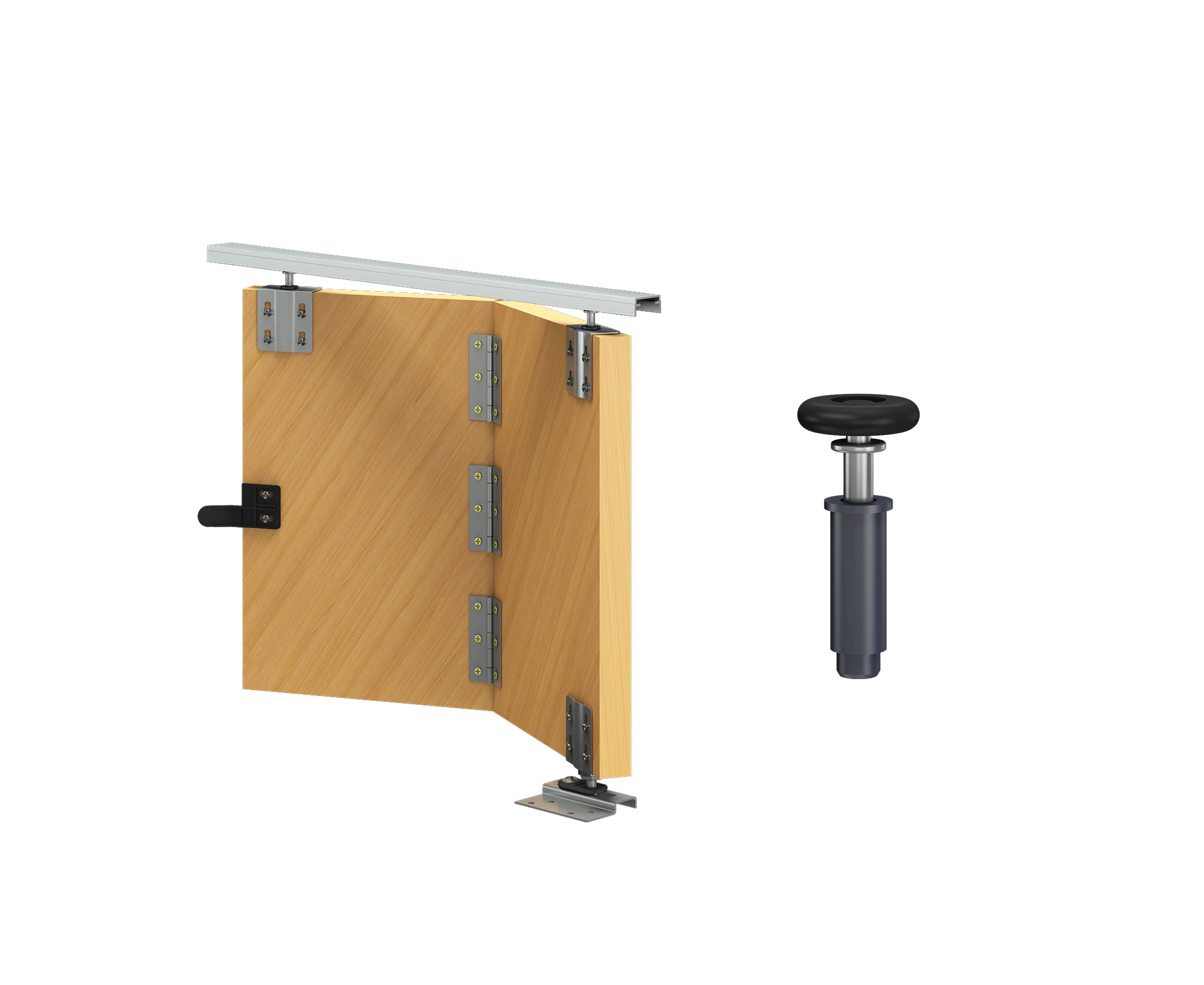
In a typical two-leaf folding door, the motion is defined by a pivot axis and a guided path. Ruedamas describes the kit as a set of parts—upper and lower pivots, a pivot with wheel, bases, a spring stop, an aligner, reinforcements, hinges, and installation screws—intended to establish a clear geometric center and maintain the door’s path without forcing the material.
For the woodworking and furniture industry, the key is that this turns an artisan solution (each installer chooses hinges, rollers, guides, and improvises) into an industrializable one: specify the kit, follow a sequence, and get repeatable behavior across many units and many teams.
3) Design parameters: leaf width, thickness, capacity, and stiffness
Public product information provides practical boundaries for specification. For the Plegamás kit, Ruedamas indicates a maximum width of 70 cm per leaf (with equal leaves) and an 18 mm thickness reference, plus an important operational detail: height adjustability for accurate alignment. This kind of constraint is not merely “catalog talk”—it defines a safe region where the mechanism can keep the door stable without overloading pivots or rails.
In the simple kit datasheet, Ruedamas mentions a capacity of 20 kg per leaf (two-leaf system), positioning it for lighter fronts and typical residential use. In the reinforced version, the company mentions four-wheel carriages (with a body in polyamide reinforced with glass fiber) and a capacity of 60 kg per leaf. The reinforced installation guide also raises the reference to a minimum 20 mm panel thickness. From an engineering standpoint, this speaks to fatigue resistance and wear behavior under heavier fronts—useful when leaves are composite (wood + mirror, framed doors) or when cycles are intensive (rental units, hospitality, retail back-of-house).
4) Installation as a process: avoiding tolerance stack-up
In wood joinery, failures are rarely caused by a single “bad part”. They are usually caused by stacked deviations: out-of-square cabinets, slight rail misplacement, uneven anchoring, and rushed final adjustment. A kit reduces decision-making, but good results still depend on treating installation as a process:
- Check squareness and plumb of the opening. Folding systems make errors visible faster.
- Reinforce and anchor at load points. Pivots and guides must sit in sound material (and should be backed by reinforcement where needed).
- Adjust under real load. Fine tuning should be done with the leaves installed, not “in air”.
- Use stops and alignment features as life-extenders. They prevent users from forcing the mechanism and protect the system over time.
In other words: adjustability is not a cosmetic feature—it’s the tool that makes the mechanism resilient to real-world tolerances.
5) Industrial impact: less rework, better perceived quality
When a folding door works well, the benefits go beyond “it opens”. There are industrial effects that matter:
- Shorter installation time and fewer callbacks: a kit standardizes decisions and reduces improvisation.
- Lower premature wear: controlled trajectory and better load distribution reduce edge damage and fastener fatigue.
- Better user experience: smooth folding and consistent alignment raise perceived quality.
- More design freedom: folding systems enable fronts where swing doors are inconvenient and sliding doors are structurally limiting.
For manufacturers, the true cost of hardware is not only the part price—it is the cost of adjustment, service, and reputation.
6) Where the trend is going: modularity and compatibility with modern production
The broader direction of the industry is system-based design: fewer loose parts, more integrated modules. Three forces drive it:
- Larger, heavier fronts (more accessories, more glass, more integrated lighting).
- CNC-driven production and repeatable processes (where kits simplify drilling patterns and assembly).
- Market expectation for quieter, adjustable motion even in mid-range furniture.
In this context, folding kits evolve toward higher load ratings, more stable materials (reinforced polymers, better-protected rolling elements), and clearer installation documentation. The industrial value is uncertainty reduction: the front looks right on day one—and still behaves right after thousands of cycles.
Editorial close
The best hardware is the kind that doesn’t become a discussion: it installs without “tricks”, performs consistently, and ages well. Folding doors demand more from geometry and load control than swing doors, so the difference between an improvised assembly and a designed kit shows up in every opening cycle. Systems like Ruedamas’ Plegamás place the focus where it belongs: constraints, adjustment, load, and process—the everyday engineering behind reliable motion.