Silent furniture motion: GRASS slides and hinges via LUAN
LUAN brings GRASS motion platforms—concealed slides, drawer systems and hinges—focused on repeatability, silence and long-term stability in cabinetry.
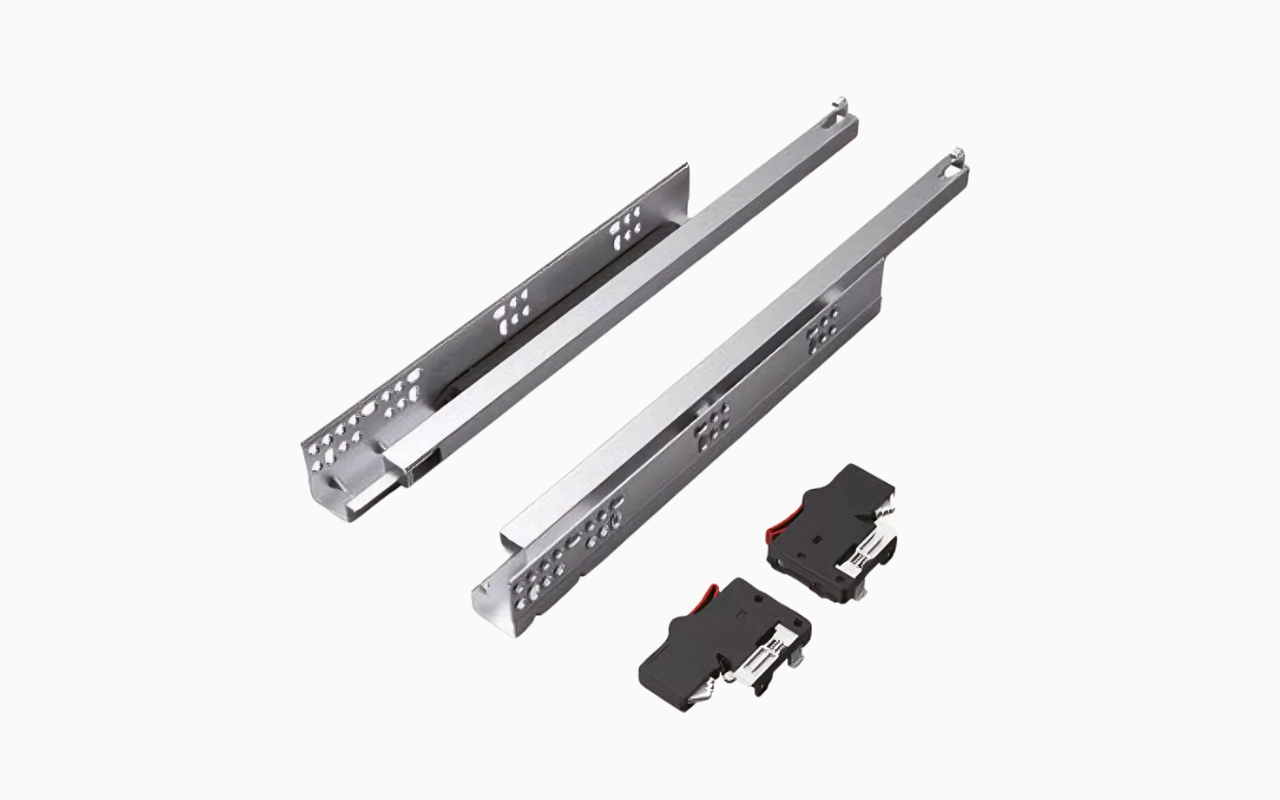
In the furniture industry, “finish quality” no longer ends with the last edge band or the final sanding pass. Increasingly, perceived quality is defined by a daily gesture: opening a drawer with minimal effort, closing a door without impact, or accessing an upper cabinet with controlled, predictable motion. That micro-moment concentrates engineering requirements that remain hidden behind the front: stiffness, synchronization, damping, adjustment during assembly, and endurance across repeated cycles. When a user says “this feels solid,” they are often describing—without realizing it—the quality of the motion system. In Argentina, LUAN (Ferroplastica Olivos S.R.L.) built a long-standing presence supplying furniture manufacturers and hardware distributors with wheels and accessories, and later expanded into fittings and components. A key milestone was becoming the local representative/distributor of Austrian GRASS motion systems, bringing to the market a coherent portfolio of concealed slides, drawer platforms and hinge solutions with soft-close damping and push-to-open options. The technical consequence is important: these are not isolated parts, but systems that shape the cabinet design, influence production steps, and determine in-use performance. ## 1) The slide as the drawer’s backbone: stability, synchronized travel, and adjustment In modern cabinetry, a slide is not merely a “glide.” It behaves as part of the structure: it controls travel, limits racking, supports load, and stabilizes the front under asymmetric operation (for instance, when the user pulls a drawer from one corner). LUAN’s presentation of the concealed Dynapro family positions it for wooden drawers or metal side systems such as Vionaro: synchronized slides with load capacity up to 40 kg, 4D adjustment, and soft-close damping for controlled closing. Synchronized motion is a practical answer to everyday use in kitchens and high-traffic furniture, where uneven pulling is common and racking creates noise, wear and misalignment. From a production perspective, 4D adjustment is not a marketing phrase—it’s an industrial tool. Visible drawer fronts can be lacquered, veneered, textured, or carefully color-matched; fine adjustment in multiple directions reduces rework and speeds up final tuning during installation. It also acts as a buffer for process variability (panel thickness dispersion, wood movement with humidity, drilling tolerances in CNC work). And the optional Tipmatic Soft-Close concept—push-to-open plus a quiet, damped close—directly supports the growing trend of handle-less fronts, where the mechanical interface must remain reliable over thousands of cycles. For lower-load applications or projects that prioritize simpler adjustment, LUAN also highlights Dynamoov as a concealed solution for wooden drawers: synchronized motion, load capacity up to 30 kg, 1D adjustment, and soft-close and Tipmatic options. In workshop reality, this matters because the same manufacturer may produce everything from lightweight bathroom drawers to deep kitchen “pots and pans” drawers. Having motion platforms across defined load ranges makes it easier to standardize the process without overengineering every module. ## 2) Drawer systems: when design demands repeatability Drawer platforms are where motion and aesthetics meet. LUAN describes Nova Pro Scala as a system with synchronized slides and load capacity up to 40 kg, soft-close damping, and an optional Tipmatic Soft-Close configuration. Standard nominal lengths (300 to 500 mm) and profile heights enable product families with consistent proportions: shallow cutlery drawers, mid-height utility drawers, deep cookware drawers, and pantry modules that maintain a unified visual language. Repeatability is a competitive advantage in industrial woodworking. It supports a “kit logic” where cutting lists, machining programs, and assembly sequences become predictable. Hole patterns, fixing positions, clearances, and squareness become more method-driven and less dependent on artisanal correction. The downstream effect is shorter assembly time, fewer call-backs, and simpler maintenance. Vionaro adds a strong design direction: slim metal sides (often cited around 13 mm in this family) maximize usable volume while delivering a minimalist look. The technical challenge is maintaining stiffness and stable travel with less visible material. That is where synchronized slides and multi-axis adjustment become decisive, because minimal design is unforgiving—misaligned fronts and imprecise closing immediately degrade perceived quality. ## 3) Hinges: soft-close control, opening angles, and door tolerances If drawer systems define the horizontal user experience, hinges define the vertical one. LUAN’s Tiomos presentation centers on integrated Soft-Close damping (with 3-level adjustment), 3D regulation and click-type mounting. From an engineering standpoint, integrated damping reduces impacts that, over time, loosen screws, deform mounting plates, or damage door fronts. Damping adjustment matters because door mass and materials vary significantly: a lightweight melamine front is not the same as a tall door with glass, aluminum frames, or solid wood. 3D regulation and multiple fixing methods (screw-on, expanding, or pressure-based variants) align with production realities: different board densities, CNC drilling patterns, short runs and long runs. The ability to “center” doors after assembly helps protect visible gaps, lines and reveals—details that define premium furniture—and it reduces the temptation to apply improvised fixes that become failures months later. Tiomos Hidden adds another layer: high-end projects often demand hardware that is not visible, yet feels precise. With an opening angle of 105°, 3D adjustment, Tipmatic options, minimum door thickness guidance (from 18 mm), and load capacity references (up to 17 kg), hinge selection shapes the design from day one: material choice, thickness, geometry, and even the door type (wood or aluminum). ## 4) Real-world application: “making the invisible visible” LUAN’s value proposition is strengthened by demonstrable use cases rather than catalog claims. In Casa FOA 2019, for example, the concept was to let visitors open and close furniture elements throughout the exhibition—drawers, doors, lift systems—so motion became part of the experience. This is more than a showroom trick; it functions as ergonomic validation. If a push-to-open system requires too much force, or if soft-close timing feels slow or inconsistent, users notice immediately. In industrial design, perception is data. ## 5) Trends and the next step: from mechanical parts to integrated systems Market direction is consistent: handle-less fronts, more daily cycles in kitchens and wardrobes, modular furniture, and a higher expectation for silence and precision. The next frontier is not simply adding features, but integrating motion systems into the whole process: parametric design, repeatable CNC machining, faster installation, and simpler after-sales service. In that context, LUAN’s combination of locally produced accessories and a GRASS motion portfolio is relevant to the Argentine furniture ecosystem because it brings measurable parameters (load classes, adjustment ranges, damping options) that help designers and manufacturers reduce uncertainty. The editorial conclusion is straightforward: a cabinet can look beautiful in a picture, but it becomes “good” through use. Motion is no longer a detail—it is a core technical specification. Choosing slides, drawer systems and hinges is not a purchase of parts; it is an engineering decision that shapes daily user experience and industrial efficiency.