The worlds first wooden city is under construction: where it is and why it challenges concrete
Building an entire city made of wood is no longer a futuristic idea. In Sweden, that concept began to take concrete form with the development of Stockholm Wood City, the largest urban development in the world made entirely of industrialized structural wood. The project is built in the Sickla district, south of Stockholm (the capital of this Scandinavian country), and proposes a new way of thinking about how homes, offices and commercial areas are built within a contemporary city.
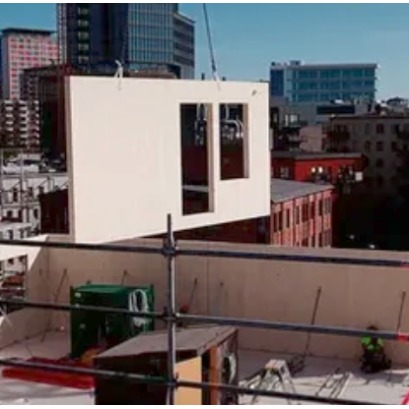
The estimated investment exceeds US$500,000,000 and the development occupies an area of ??close to 250,000 m2. The plan includes around 30 buildings distributed in about 25 urban blocks, with the capacity to house 2,000 residents and receive about 7,000 workers. The objective is to consolidate a mixed-use district, active throughout the day, where living, working and consuming are part of the same urban fabric. Work began in 2024 and has already progressed on several buildings that are entering their final stage. The first deliveries are scheduled between the end of 2026 and 2027, while the total completion of the project is projected for 2029. The progress of work confirms that the wooden city is no longer an experiment but has become a real development, with an urban impact and scale comparable to central sectors of a European capital. The project is located in an old industrial area that in recent decades has undergone a sustained process of reconversion. The masterplan orders growth with a compact city logic, prioritizing pedestrian routes, public spaces and a strong integration between the different uses. Shops and gastronomy are developed at street level, while homes and offices are organized in height, with a direct relationship with the urban space. With what system it is executedThe choice of wood as the main structural material marks the strongest break with traditional architecture. The construction system is based on cross-laminated wood, known as CLT, a technology that allows buildings to be erected in height using industrialized pieces that are assembled on site with dry assembly. This method shortens construction times, improves precision, reduces waste and reduces the impact on the urban environment during construction. The lower weight of the wood reduces the need for large foundations and significantly lowers heavy traffic and noise levels during construction. Unlike concrete, wood not only generates fewer emissions in its production process, but also stores carbon. The CO2 captured by trees during their growth is retained in the structure of the buildings throughout their useful life, transforming buildings into carbon reservoirs within the city. The urban proposal is not limited to construction material. Stockholm Wood City was designed as an integrated energy system. The district uses self-generated energy, stored and shared between buildings. Heat and cold are managed through a geothermal network connected to a large underground reservoir, while the installation of solar panels is progressively expanded to reinforce energy supply.Sustainable focus and dataUrban planning prioritizes sustainable mobility, with streets designed for pedestrians and bicycles, and a strong connection with public transport.The objective is to reduce car use and improve the environmental quality of the complex, in line with Swedens climate goals. Below, the Worlds first wooden city in data:• Estimated investment: more than USD 500 million.• Total development area: 250,000 square meters.• Location: Sickla district, south of Stockholm, Sweden.• Developer: Atrium Ljungberg.• Start of construction: 2024.• Completion of the first buildings: expected between 2026 and 2027.• Number of buildings: around of 30.• Number of urban blocks: approximately 25.• Land use: mixed-use development.o housingo officeso commercial areaso gastronomyo public spaces• Projected capacity:o 7,000 office workerso 2,000 residents• Urban scale: area equivalent to the historic center of Stockholm.• Main construction material: structural wood.• Estimated reduction in emissions: up to 60% less carbon compared to traditional methods.• Energy system:o energy self-generated, stored and shared. o geothermal network for heat and cold. • o continuous expansion of solar panels. Could a project like this come to Argentina: When? From the Argentine perspective, the Swedish case works as a reference and as a possible horizon. Daniel Vier, general secretary of the Argentine Federation of the Wood and Related Industries and president of the Argentine Chamber of Wood (CADAMDA), maintained that to advance towards large-scale urban developments in wood it is necessary to align three axes simultaneously: the technical, the regulatory and the productive. On a technical level, he states that Argentina has forestry resources and available technology, but it still needs to expand the training of architects, engineers and specialized labor in systems such as CLT. On a regulatory level, the challenge is to update municipal and provincial building codes to consider wood in larger buildings, simplifying approvals and generating predictability for developers and investors, said Vier. In productive terms, the country has more than 1.3 million hectares of cultivated forests, with growth rates among the highest in the world, which opens a concrete opportunity to industrialize more at source and strengthen regional value chains. Within this journey, regulatory updating and productive capacity are key. Large-scale wood construction requires clear rules that enable greater height, predictability for investors and an industrial framework capable of producing value-added engineered components. Added to this is the training of professionals and specialized labor, along with access to financing, as necessary conditions for the system to gain scale and continuity. Vier said that Argentina has already demonstrated that it can incorporate new technologies when there is decision and coordination. He stated that, if progress is made in clear regulatory frameworks, professional training, financing and demonstration projects that function as lighthouses, in a few years the first neighborhoods or medium-scale buildings built in wood could appear, capable of setting a course for the sector. He also pointed out that Swedens leadership responds to a long-term vision that integrated forestry policy, industrial development, urban planning and climate goals under the same strategy. Vier indicated that projects like Stockholm Wood City are the result of decades of investment in technology, education and clear rules, and concluded that Argentina has the necessary resources, knowledge and talent to move in that direction, as long as it achieves coordination, continuity and confidence to scale the model.