Plant aerodynamics: how trees resist wind storms without breaking
When a very strong wind, some trees bend without breaking and others fall. The key is in its natural aerodynamics: roots, flexibility of the trunk and shape of the crown.
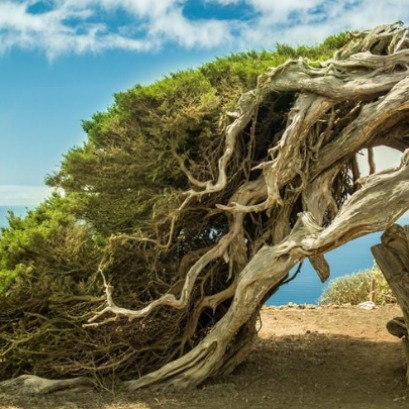
When a wind storm hits forests and cities, the scene can seem chaotic: some trees bend almost touching the ground and survive, while others snap like matches. Why does this happen? The answer lies in aerodynamics and that in the plant world translates into deep roots, flexible trunks and intelligent crowns. Why do some trees bend and others break? In the face of a hurricane or intense storm, a tree can fail in two ways: by uprooting or splitting at the trunk, and the difference depends on three key factors. • The root system • The structural flexibility of the trunk • The size and shape of the crown Some species are designed to bend and dissipate the energy of the wind, while others, more rigid or with superficial roots, accumulate too much tension and end up giving way. In physical terms, the wind exerts a force that increases exponentially with speed. The sabina learned that the best way to survive adversity was by adapting to the constant onslaught of the trade winds, and in that process of flexibility she achieved beauty (Island of El Hierro). The decisive role of the rootsThe root system is the anchor of the tree being the stabilizing roots of the structure. There are two main strategies. • Deep roots (pivoting): they penetrate vertically into the soil, providing great stability. They are common in species adapted to dry terrain. • Superficial and extended roots: they expand horizontally, creating a wide but shallower network. They work well in compact soils, although they can be more vulnerable if the ground is saturated with water. In the Iberian Peninsula, for example, the oak stands out for its powerful tap root, while some pines develop more superficial systems, especially when they grow in poor or shallow soils. When the ground is waterlogged after heavy rains, even robust trees can be uprooted because the ground loses cohesion. Trunk flexibility: bending so as not to break Wood is not a rigid material and inert: it is composed of fibers that allow a certain degree of bending.• Young trees tend to be more flexible, since their tissues are not yet completely lignified.• On the other hand, older specimens or those with denser wood may be more prone to fractures if the wind exceeds their deformation capacity.• Mediterranean pines, such as the Aleppo pine, are relatively flexible and tend to bend before breaking. On the contrary, species with harder wood and a heavy crown can suffer fractures in the trunk or in large branches if the stress exceeds their structural limit. • The crown: reducing resistance to survive • One of the most determining factors is the shape of the crown, and from an aerodynamic point of view, the greater the surface exposed to the wind, the greater the pressure the tree supports. Many species naturally reduce the density of their foliage in windy areas, and for example in coastal or high mountain environments the trees usually reduce present more compact or deformed crowns due to the dominant wind.Some key mechanisms are the following.• Small or needle-like leaves that reduce friction (as in pines).• Less dense crowns that allow air to pass through.• Selective loss of branches in extreme episodes, which lightens the structure.It is a clear strategy: less resistance equals less risk of breakage.Comparison between Iberian speciesClear differences in behavior against wind are observed in the Iberian Peninsula.• Holm oak (quercus ilex): deep root and robust trunk. It resists well thanks to its powerful root system and its relatively compact crown. • Aleppo pine (pinus halepensis): flexible and adapted to exposed environments. However, in shallow soils it can be vulnerable to overturning.• Beech (fagus sylvatica): common in the humid north. It has more superficial roots, so in saturated soils it may be more susceptible to uprooting.• Eucalyptus: fast growing and less dense wood. In intense storms it can suffer fractures, especially in dense plantations. Each species combines rigidity, flexibility and anchoring in a different way. There is no indestructible tree, but rather specific adaptations to the environment in which it evolved.