Curiosities of nature
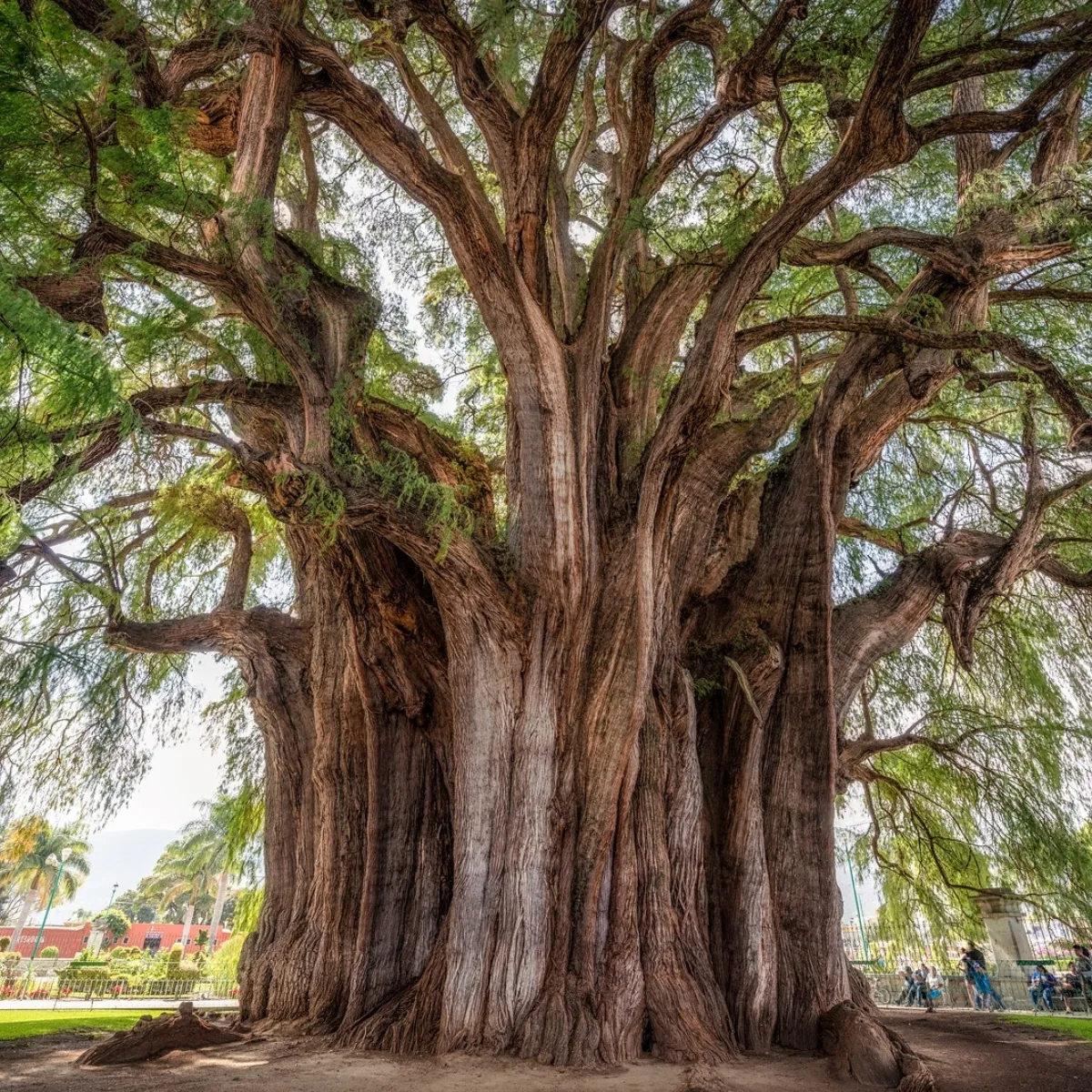
The Tule Tree in Oaxaca, Mexico
In Oaxaca, Mexico, there is one of the trees with the largest trunk circumference in the world. The Tule tree, as it is known, exudes fullness at its nearly 2,000 years of age since, according to legend, it was planted in a sacred place. If 10 midsize cars were placed side by side in a circle, this would be about the same size as the circumference of this tree. The species is native to Mexico, although it is also found in very localized areas of southern Texas and northwestern Guatemala. In 1921, to celebrate the centenary of Mexican independence, the species was selected as a national tree for its splendor, beauty, longevity, colossal dimensions, and tradition. Fortunately, its wood is soft and weak, so it is not used for construction.
According to a Zapotec legend, it maintains that it was planted about 1,400 years ago by Pechocha, priest of Ehécatl, god of the wind. Another legend says that some leaders of the great nations met and decided to separate into 4 groups, heading to the 4 cardinal points and in each one they planted ahuehuetes, the great Tule would be one of them. There is a tendency to affirm that its location is a sacred site.

IT MAY INTEREST YOU
 Native forest | In Misiones, controls are tightened on routes for illegal transport of native wood, logging of forests without permits and fraudulent digital guides
Informality in forestry activity in Misiones was once again evident, the culture of operating illegally is a historical problem, and the Ministry of Ecology and Renewable Natural Resources carries out the corresponding control and inspection operations in the regulation of productive activity and sustainable management for the use of native forests.
 The DNA of forests: they discover what makes a tree resist drought
An international team, with the participation of INTA and Conicet, discovered that genetics can be decisive for trees to better resist droughts
 Canadian researchers make biochar from wood waste that rivals steel in strength
Researchers at the University of Toronto have developed monolithic biochar from wood that can reach an axial hardness of up to 2.25 GPa, similar to mild steel.