
Pine firewood: a study in Lanín Park debunks myths and confirms its power to heat
A study carried out within the framework of the Pewén Project, in the Lanín National Park, demonstrated that pine firewood, when properly dried, has a good caloric value and can be an alternative to the shortage of native firewood. The research also seeks to take advantage of the advance of pines and reduce their impact on araucaria and nothofagus forests.
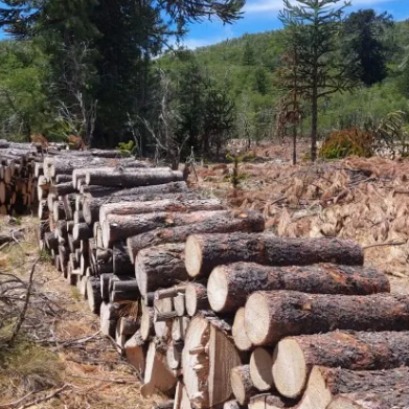
Despite popular beliefs, pine firewood has a caloric value similar to that of native species. This was determined by a study carried out by a team of researchers within the framework of the Pewén Project, an initiative for the conservation and restoration of ancient araucaria forests promoted by the Lanín National Park, together with the Pewenche Zonal Council and the Puel Mapuche community. The report was published in a scientific journal called Austral Ecology. The idea was to test these preconceptions about pine firewood. There are two great fears for which it is rejected: it is thought to be bad and does not have an adequate caloric value, but it is also thought that it is not safe because it has resin and clogs the ducts, said Hernán Attis Beltrán, from the Science and Technology Area of ??the Department of Conservation and Management of the Lanín national park. The concern that motivated the study was: how to find a solution to meet the demand for firewood in the area given the shortage of native firewood? The target then pointed in two directions. On the one hand, reduce the consumption of native firewood since there is less and less and it plays an important role in the forest. Another reason is linked to the large number of pine trees in plantations and invasions that advance on the araucaria and nothofagus forests. The main indicator of the quality of firewood is the density of wood and when comparing the density of the pine with the native species there are not many differences, specified this doctor in Biology and forestry engineer. Another of the fundamental indicators is the moisture content. Good wood, even if it has a high moisture content, is not good firewood. We saw that when pine firewood was used, very wet, humid, green wood was used. Thus, it is very deficient: it does not generate heat, it is difficult to light it, it generates smoke that is toxic and affects health, described Attis Beltrán. The challenge then was to evaluate how the pine wood could be dried. The trials were carried out in Villa Pehuenia – Moquehue, with the Puel Mapuche community, using two strategies. The pieces of wood - 30 centimeters long and 15 centimeters in diameter - were placed in piles: some piles of firewood were covered with black polyethylene and others were not dried. This is how we measured the moisture content in the summer. We noticed that the effect of black polyethylene was important because in this way, with the sun, high temperatures were generated. With air circulation it dried and allowed it to reach adequate moisture content, he specified. Adequate firewood must contain between 20 and 25% humidity. Each month, measurements were made of the covered and uncovered rumas. When they reached autumn, they detected that those that were not covered had a very high moisture content. The second stage of the test was to put into operation the two types of firewood and even the native firewood that they generally used. Each family, in three identical stoves, heated water to measure the temperature, speed and calories that were generated, he mentioned. In that instance, it was detected that pine firewood - when dry - reaches the necessary conditions and can often be better than native firewood, which sometimes presents humidity or rot. How dangerous is pine firewood? The work did not stop there. The researchers promoted talks with the firefighters of Aluminé and Pehuenia to teach how to clean the ducts of chimneys and stoves, in relation to safety and to reduce the amount of smoke. When the firewood is dry, high temperatures are generated in the combustion chamber. This causes these resins to burn in a different way and not accumulate in the ducts, he said. Attis Beltrán warned that Chile has several tests in which the quality of the firewood has been characterized. It happens that in that country, the demand for firewood is greater since few cities have gas. The work in the Lanín park, within the framework of the Pewen Project, which promotes the use of pine firewood as a strategy to generate heat and reduce invasions and unmanaged plantations, was declared of provincial interest by the Legislature of Neuquén. The community of Villa Pehuenia - Moquehue chose to begin using it to reduce the use of the native forest. The added value was hand in hand with the communities. They surprised themselves. The good thing was that they were not given a recipe to try to convince them but rather that they themselves were part of the change, he highlighted. The next stage is to get more people to try pine firewood. Let it be known, let experiences be shared. Furthermore, the idea is to enable communities to organize. They usually look for firewood before winter arrives and the ideal time with pine firewood is when it ends. You have to cut the trees and leave the firewood prepared all summer so that it dries well when the time comes, he concluded. What is recommended? Specialists suggest cutting the pine in September (before the trees sprout and the sap rises) and into logs of at least one meter. It is important to cut into pieces to begin drying. The logs should be no more than 30 centimeters long and 15 centimeters in diameter, they say. Then, they should be stacked in piles no more than 1.5 meters high and 1.5 meters wide - and no more than 4 meters long. They should always be separated from the floor and covered on top and on the sides. The wait should last at least four months for the firewood to dry well and the ideal, they add, is to use it when the stove is already very hot. However, the firewood must be dry for safety, health and energy efficiency. Stove or chimney ducts should be as straight as possible and reach a sufficient height to ensure good ventilation and smoke escape.