
Missions | 22 hectares of a unique grassland in Argentina were burned and populations of endemic species were lost in protected areas of Teyú Cuaré
At the end of September, a fire was reported in San Ignacio, where 22 hectares of grassland were burned on the Teyú Cuaré peninsula, a protected natural area in the province of Misiones. The most affected area was the Tenondé Private Nature Reserve, property of the Habitat and Development Foundation.
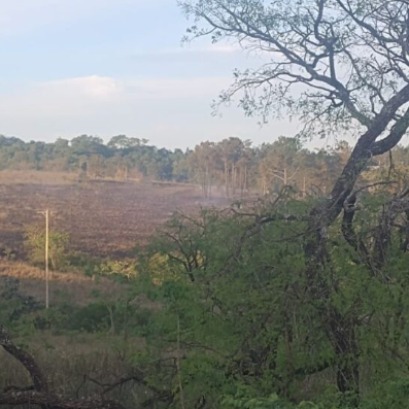
The fire originated during work to replace a pole on the power line that borders the grassland and advanced quickly. There were no victims or material damage. The person in charge of the reserve was at that time in an area without telephone coverage. The residents of the peninsula, the park rangers of the Teyú Cuaré Provincial Park and the Osununú Reserve, the volunteer firefighters and the San Ignacio police, who also documented what happened, came to the aid. Serious damage to unique species The regrettable environmental fact recorded is that part of the burned protected area had been acquired this year with the contribution of the Netherlands Committee of the International Union for Conservation of Nature (IUCN NL), for housing numerous species exclusive to the south of Misiones, several of them declared Provincial Natural Monument and integrated into the Provincial System of Protected Areas. It is estimated that the fire affected specimens of some 500 species of vascular plants, in addition to mammals, birds in the nesting period, lizards, snakes and frogs. Among the most relevant losses: • The entire local population of Lessingianthus teyucuarensis, a third of the world population.• 80% of the local population of Eugenia lilloana and Allagoptera campestris (in both cases, half of the existing population).• The entire local population of Distimake tenondensis, half of the existing population.• 50% of the local population of Butia poni, 40% of the existing population.• Several hundred specimens of the tree fern Cyathea atrovirens, Provincial Natural Monument.• The entire wetland where Rufirallus schomburgkii lives, a very rare bird in Argentina. From the environmental organization they specified that the fire did not reach the "cerrito" grassland, on the other side of the road, where microendemisms persist such as the grass Mesosetum comatum and it is the only place where Hedeoma teyuciarensis and Oxypetalum teyucuarense grow spontaneously. Fire as part of the ecosystemFrom the Habitat and Development Foundation they explained that this Grassland is part of the small portion of the Cerrado present in Argentina: less than 250 hectares distributed in patches in San Ignacio, Santa Ana and Candelaria. The biome, well represented in Paraguay, Brazil and Bolivia, is made up of species adapted to drought and fire, which is part of its natural dynamics. In large areas, one part burns while another remains and provides seeds. The risk appears when almost an entire isolated patch burns, such as that of Teyú Cuaré: the species may not recover in time or be displaced by colonizers, such as some grasses of African origin present in the area, they detailed. At the same time, the fire eliminated part of the trees and bushes that had been advancing on the grassland and returned a strip of about ten meters. Its medium-term effects are still uncertain, they indicated. Proper management of this environment includes periodic and small-scale controlled burning, which reduces the accumulated dry biomass and generates sectors in different states of recovery, with a greater variety of habitats for fauna. In that sense, they considered that carrying them out outside the nesting and breeding season, between October and March, also allows reducing the impact on the animals. Next steps: restoration of the areaTo better understand this environment, little studied in the country, the Faculty of UNaM Forest Sciences initiated the project "Restoration of grasslands on sandstones of Misiones, Argentina", directed by doctors Héctor Keller, specialist in plant identification, and Diego Broz, specialist in fire management. Permanent plots will be installed to evaluate whether endemic species manage to reestablish themselves or if others, exotic or native, advance. Implementing controlled burning will require trained personnel, protection and fire fighting equipment and, ideally, a source of water at the edge of the grassland. For this, the Foundation has the support of the Ministry of Ecology, the residents and park rangers of the peninsula, the Faculty of Forestry Sciences and thousands of missionaries who value their natural heritage, concluded the environmental organization.