
They bury tree trunks underground to cool the planet: they store carbon for more than 1,000 years
This innovative method buries woody biomass in clay soils to prevent decomposition and keep carbon out of the atmosphere With the advance of climate change, innovative proposals are beginning to emerge to reduce greenhouse gas emissions and remove carbon from the atmosphere. One of them relies on a resource as simple as the trunks of dead trees.
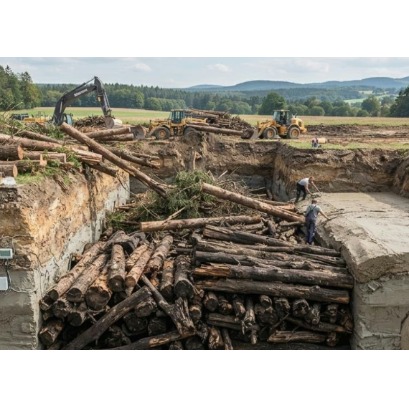
This is the Carbon Lockdown Project, an initiative promoted by the American public benefit company Carbon Lockdown Project Benefit LLC, which proposes a form of carbon storage known as wood vaulting. They bury trees to trap carbon for more than 1,000 years. The objective is to conserve the carbon captured by the trees while they were alive for centuries, preventing it from returning to the atmosphere in the form of carbon dioxide (CO). The company exclusively uses woody biomass that no longer has commercial use and would otherwise end up decomposing or being incinerated. Among the materials used are remains of urban pruning, wood from demolitions, trees felled by storms and specimens killed by pests or diseases. To conserve this carbon, the trunks are deposited in large underground trenches or, when possible, in abandoned mines and quarries. These deposits are preferably built on soils rich in clay or silt, since these materials have a very low permeability and make it difficult for water and oxygen to enter, two essential elements for the decomposition of wood. How are these trees buried? The procedure consists of introducing the trunks of practically unprocessed trees and covering them with a thick layer of compacted clay. In this way, an anoxic environment is created, that is, without oxygen. Under these conditions, the fungi and microorganisms responsible for degrading wood cannot develop, so the carbon remains trapped in the material instead of being released again as CO. According to the company, this storage could keep carbon immobilized for more than 1,000 years if the deposit remains stable. To verify that the system is working correctly, the storage sites have sensors that monitor subsoil conditions. Additionally, projects are audited under specific carbon removal methodologies. Once permanent storage is verified, Puro.earth, an international carbon removal certification platform, issues carbon removal certificates that can be purchased by companies interested in offsetting part of their emissions. The income obtained makes it possible to finance the maintenance of the system and generate economic activity in the rural communities where these projects are developed.In a nutshell• A company preserves the carbon of dead logs by burying them in mines and quarries.• The initiative seeks to avoid the release of CO2 from woody biomass, trapping the carbon for centuries.• The projects are audited and generate carbon removal certificates to offset corporate emissions.